

-
1 страховка на случай необходимости (precaution in case of emergency)
Graphic expression: act as a backstopУниверсальный русско-английский словарь > страховка на случай необходимости (precaution in case of emergency)
-
2 получать
(= получить, см. также доказывать, обосновывать, устанавливать) get, obtain, receive, derive, deduce• Антенна используется для того, чтобы получать сигналы. - An antenna is used to receive the signal.• Более удобные формы решения были получены Смитом [1]. - More convenient forms of solution have been obtained by Smith [1].• Вот почему мы смогли получить... - This is why we were able to obtain...• Вычислив коэффициенты, мы можем получить... - Having calculated the coefficients, we can obtain...• Д-р Смит получил премию Джонса в конце июня. - Dr. Smith received the Jones Award in late June.• Давайте использовать это решение, чтобы получить... - Let us use this solution to obtain...• Далее, мы можем получить полезную информацию, изучая... - We can then obtain useful information by studying...• Данная идея получила свое начало при исследовании... - The idea originated with the study of...• Действуя аналогично, получаем, что... - By a similar procedure, it follows that...• Для обозначенной ориентации мы получаем... - For the orientation shown, we have...• До тех пор, пока не..., этот вопрос не получил ответа. - The question remained unanswered until...• Дополнительную информацию можно часто получить из... - Additional information can often be obtained from...• Ему удалось получить уравнение... - Не succeeded in obtaining the equation of...• Затем мы получим явные выражения для... - We next obtain explicit expressions for...• Из второго равенства мы получаем... - From the second equality, we have...• Легко получаем, что... - It follows without difficulty that...• Можно получить явное выражение для... - It is possible to obtain an explicit expression for...• Мы могли бы получить еще другую форму (чего-л). - We may obtain yet another form of...• Мы могли бы получить этот же результат более просто, заметив, что... - We could have obtained this result more easily by noting that...• Мы можем получить данный результат следующим образом. - We can obtain the result as follows.• Мы можем получить то же самое заключение другим способом в случае, когда... - We can reach the same conclusion in another way for the case of...• Мы надеемся получить теорему о... - We hope to obtain a theorem regarding...; We hope to establish a theorem regarding...• Мы снова получили... - Again we have obtained...• Мы также можем получить выражение для... - We can also obtain an expression for...• На этом пути мы можем получить (вывести и т. п.).. - In this way we can arrive at...• Невозможно получить полное понимание... без основополагающих знаний... - It is impossible to gain a thorough knowledge of... without a basic knowledge of...• Некоторое понимание причины такого поведения можно получить (проделывая и т. п.)... - Some insight into the reason for this behavior can be gained by...• Оставляя этот случай в стороне, получаем, что... - Leaving this case out of consideration, it follows that...• Очевидно, что мы не можем получить никакой ошибки из... - Obviously no error can result from...• Подставляя (1) в уравнение (2), мы получаем... - Substituting (1) into (2), we obtain...• Полагая у - х, мы получаем... - Setting у = х, we obtain...• Получим теперь решение... - We shall now derive a solution of...• Пользуясь вторым законом Ньютона, мы получаем... - By Newton's second law, we have...• Прекрасное совпадение с экспериментальными данными обычно можно получить... - An excellent fit to experimental data can usually be obtained by...• Преобразуя подобным образом остальные члены, мы получаем... - Transforming the remaining terms in a similar manner, we obtain...• Простое и прямое доказательство может получить (применением и т. п.)... - A simple and direct proof can be obtained by...• Решения этих уравнений можно получить графически (с помощью и т. п.)... - Solutions to these equations can be obtained graphically by...• Сначала мы получим... - Initially, we will obtain...• Таким образом, мы получаем выражения... - In this way we obtain the expressions...• Теперь мы получаем возможность... - This raises the possibility that...• Теперь мы получили желаемый результат. - We now have the desired result.• Теперь мы получим альтернативное выражение для... - We now obtain an alternative expression for...• Теперь мы получим полезный критерий для... - We now obtain a useful criterion for...• Теперь нам будет достаточно получить... - Here we shall be satisfied to obtain...• Тот же самый результат можно получить простым (вычислением и т. п.)... - The same result may be obtained by simply...• Точные решения уравнения (1) можно получить в терминах известных функций, когда... - Exact solutions to (1) can be obtained in terms of known functions when...• Трудно получить относительно чистый образец данного материала. - It is difficult to obtain a relatively pure sample of the material.• Чтобы получить (2.2), отметим, что... - То obtain (2.2), we note that...• Чтобы получить необходимый результат, мы... - То obtain the required result, let...• Чтобы получить неявное выражение для f(x) предположим, что... - То obtain an explicit expression for fix), suppose that...• Чтобы получить практический результат в подобных случаях, мы... - То obtain a practical result in such cases, we...• Чтобы получить удовлетворительную теорию, мы обязаны... - То obtain a satisfactory theory it is necessary to...• Эти идеи получают немедленно приложение к/в... - These ideas have immediate application in...• Эти методы получают своих сторонников, так как... - These methods attract proponents because...• Эти результаты, очевидно, получают значительно большее значение, когда... - These matters are clearly of much greater importance when...• Это можно получить следующим образом. - This can be obtained as follows.• Это решение можно получить наиболее просто, используя... - The solution is most readily obtained by the use of...• Это соотношение можно также получить, исходя из теории электромагнетизма. - This relation can also be obtained from the theory of electromagnetism.• Этот же результат можно получить другим способом. - It is possible to obtain this result in a different way.• Этот результат можно было бы получить более легко, увидев, что... - This result could have been obtained more easily by recognizing that...• Этот результат также можно было бы получить, применяя... - This result may also be obtained by means of... -
3 БИБЛИОГРАФИЯ
Мы приняли следующие сокращения для наиболее часто упоминаемых книг и журналов:IJP - International Journal of Psycho-analysisJAPA - Journal of the American Psychoanalytic AssociationSE - Standard Edition of the Complete Psychological Works of Sigmund Freud, ed. James Strachey (London: Hogarth Press and the Institute of Psycho-Analysis, 1953—74.)PSOC - Psychoanalytic Study of the Child (New Haven: Yale University Press)PQ - Psychoanalytic QuarterlyWAF - The Writings of Anna Freud, ed. Anna Freud (New York: International Universities Press, 1966—74)PMC - Psychoanalysis The Major Concepts ed. Burness E. Moore and Bernard D. Fine (New Haven: Yale University Press)\О словаре: _about - Psychoanalytic Terms and Concepts\1. Abend, S. M. Identity. PMC. Forthcoming.2. Abend, S. M. (1974) Problems of identity. PQ, 43.3. Abend, S. M., Porder, M. S. & Willick, M. S. (1983) Borderline Patients. New York: Int. Univ. Press.4. Abraham, K. (1916) The first pregenital stage of libido. Selected Papers. London, Hogarth Press, 1948.5. Abraham, K. (1917) Ejaculatio praecox. In: selected Papers. New York Basic Books.6. Abraham, K. (1921) Contributions to the theory of the anal character. Selected Papers. New York: Basic Books, 1953.7. Abraham, K. (1924) A Short study of the development of the libido, viewed in the light of mental disorders. In: Selected Papers. London: Hogarth Press, 1927.8. Abraham, K. (1924) Manic-depressive states and the pre-genital levels of the libido. In: Selected Papers. London: Hogarth Press, 1949.9. Abraham, K. (1924) Selected Papers. London: Hogarth Press, 1948.10. Abraham, K. (1924) The influence of oral erotism on character formation. Ibid.11. Abraham, K. (1925) The history of an impostor in the light of psychoanalytic knowledge. In: Clinical Papers and Essays on Psychoanalysis. New York: Basic Books, 1955, vol. 2.12. Abrams, S. (1971) The psychoanalytic unconsciousness. In: The Unconscious Today, ed. M. Kanzer. New York: Int. Univ. Press.13. Abrams, S. (1981) Insight. PSOC, 36.14. Abse, D W. (1985) The depressive character In Depressive States and their Treatment, ed. V. Volkan New York: Jason Aronson.15. Abse, D. W. (1985) Hysteria and Related Mental Disorders. Bristol: John Wright.16. Ackner, B. (1954) Depersonalization. J. Ment. Sci., 100.17. Adler, A. (1924) Individual Psychology. New York: Harcourt, Brace.18. Akhtar, S. (1984) The syndrome of identity diffusion. Amer. J. Psychiat., 141.19. Alexander, F. (1950) Psychosomatic Medicine. New York: Norton.20. Allen, D. W. (1974) The Feat- of Looking. Charlottesvill, Va: Univ. Press of Virginia.21. Allen, D. W. (1980) Psychoanalytic treatment of the exhibitionist. In: Exhibitionist, Description, Assessment, and Treatment, ed. D. Cox. New York: Garland STPM Press.22. Allport, G. (1937) Personality. New York: Henry Holt.23. Almansi, R. J. (1960) The face-breast equation. JAPA, 6.24. Almansi, R. J. (1979) Scopophilia and object loss. PQ, 47.25. Altman, L. Z. (1969) The Dream in Psychoanalysis. New York: Int. Univ. Press.26. Altman, L. Z. (1977) Some vicissitudes of love. JAPA, 25.27. American Psychiatric Association. (1987) Diagnostic and Statistical Manual of Mental Disorders, 3d ed. revised. Washington, D. C.28. Ansbacher, Z. & Ansbacher, R. (1956) The Individual Psychology of Alfred Adler. New York: Basic Books.29. Anthony, E. J. (1981) Shame, guilt, and the feminine self in psychoanalysis. In: Object and Self, ed. S. Tuttman, C. Kaye & M. Zimmerman. New York: Int. Univ. Press.30. Arlow. J. A. (1953) Masturbation and symptom formation. JAPA, 1.31. Arlow. J. A. (1959) The structure of the deja vu experience. JAPA, 7.32. Arlow. J. A. (1961) Ego psychology and the study of mythology. JAPA, 9.33. Arlow. J. A. (1963) Conflict, regression and symptom formation. IJP, 44.34. Arlow. J. A. (1966) Depersonalization and derealization. In: Psychoanalysis: A General Psychology, ed. R. M. Loewenstein, L. M. Newman, M. Schur & A. J. Solnit. New York: Int. Univ. Press.35. Arlow. J. A. (1969) Fantasy, memory and reality testing. PQ, 38.36. Arlow. J. A. (1969) Unconscious fantasy and disturbances of mental experience. PQ, 38.37. Arlow. J. A. (1970) The psychopathology of the psychoses. IJP, 51.38. Arlow. J. A. (1975) The structural hypothesis. PQ, 44.39. Arlow. J. A. (1977) Affects and the psychoanalytic situation. IJP, 58.40. Arlow. J. A. (1979) Metaphor and the psychoanalytic situation. PQ, 48.41. Arlow. J. A. (1979) The genesis of interpretation. JAPA, 27 (suppl.).42. Arlow. J. A. (1982) Problems of the superego concept. PSOC, 37.43. Arlow. J. A. (1984) Disturbances of the sense of time. PQ, 53.44. Arlow. J. A. (1985) Some technical problems of countertransference. PQ, 54.45. Arlow, J. A. & Brenner, C. (1963) Psychoanalytic Concepts and the Structural Theory, New York: Int. Univ. Press.46. Arlow, J. A. & Brenner, C. (1969) The psychopathology of the psychoses. IJP, 50.47. Asch, S. S. (1966) Depression. PSOC, 21.48. Asch, S. S. (1976) Varieties of negative therapeutic reactions and problems of technique. JAPA, 24.49. Atkins, N. (1970) The Oedipus myth. Adolescence, and the succession of generations. JAPA, 18.50. Atkinson, J. W. & Birch, D. (1970) The Dynamics of Action. New York: Wiley.51. Bachrach, H. M. & Leaff, L. A. (1978) Analyzability. JAPA, 26.52. Bacon, C. (1956) A developmental theory of female homosexuality. In: Perversions,ed, S. Lorand & M. Balint. New York: Gramercy.53. Bak, R. C. (1953) Fetishism. JAPA. 1.54. Bak, R. C. (1968) The phallic woman. PSOC, 23.55. Bak, R. C. & Stewart, W. A. (1974) Fetishism, transvestism, and voyeurism. An American Handbook of Psychiatry, ed. S. Arieti. New York: Basic Books, vol. 3.56. Balint, A. (1949) Love for mother and mother-love. IJP, 30.57. Balter, L., Lothane, Z. & Spencer, J. H. (1980) On the analyzing instrument, PQ, 49.58. Basch, M. F. (1973) Psychoanalysis and theory formation. Ann. Psychoanal., 1.59. Basch, M. F. (1976) The concept of affect. JAPA, 24.60. Basch, M. F. (1981) Selfobject disorders and psychoanalytic theory. JAPA, 29.61. Basch, M. F. (1983) Emphatic understanding. JAPA. 31.62. Balldry, F. Character. PMC. Forthcoming.63. Balldry, F. (1983) The evolution of the concept of character in Freud's writings. JAPA. 31.64. Begelman, D. A. (1971) Misnaming, metaphors, the medical model and some muddles. Psychiatry, 34.65. Behrends, R. S. & Blatt, E. J. (1985) Internalization and psychological development throughout the life cycle. PSOC, 40.66. Bell, A. (1961) Some observations on the role of the scrotal sac and testicles JAPA, 9.67. Benedeck, T. (1949) The psychosomatic implications of the primary unit. Amer. J. Orthopsychiat., 19.68. Beres, C. (1958) Vicissitudes of superego functions and superego precursors in childhood. FSOC, 13.69. Beres, D. Conflict. PMC. Forthcoming.70. Beres, D. (1956) Ego deviation and the concept of schizophrenia. PSOC, 11.71. Beres, D. (1960) Perception, imagination and reality. IJP, 41.72. Beres, D. (1960) The psychoanalytic psychology of imagination. JAPA, 8.73. Beres, D. & Joseph, E. D. (1965) Structure and function in psychoanalysis. IJP, 46.74. Beres, D. (1970) The concept of mental representation in psychoanalysis. IJP, 51.75. Berg, M D. (1977) The externalizing transference. IJP, 58.76. Bergeret, J. (1985) Reflection on the scientific responsi bilities of the International Psychoanalytical Association. Memorandum distributed at 34th IPA Congress, Humburg.77. Bergman, A. (1978) From mother to the world outside. In: Grolnick et. al. (1978).78. Bergmann, M. S. (1980) On the intrapsychic function of falling in love. PQ, 49.79. Berliner, B. (1966) Psychodynamics of the depressive character. Psychoanal. Forum, 1.80. Bernfeld, S. (1931) Zur Sublimierungslehre. Imago, 17.81. Bibring, E. (1937) On the theory of the therapeutic results of psychoanalysis. IJP, 18.82. Bibring, E. (1941) The conception of the repetition compulsion. PQ, 12.83. Bibring, E. (1953) The mechanism of depression. In: Affective Disorders, ed. P. Greenacre. New York: Int. Univ. Press.84. Bibring, E. (1954) Psychoanalysis and the dynamic psychotherapies. JAPA, 2.85. Binswanger, H. (1963) Positive aspects of the animus. Zьrich: Spring.86. Bion Francesca Abingdon: Fleetwood Press.87. Bion, W. R. (1952) Croup dynamics. IJP, 33.88. Bion, W. R. (1961) Experiences in Groups. London: Tavistock.89. Bion, W. R. (1962) A theory of thinking. IJP, 40.90. Bion, W. R. (1962) Learning from Experience. London: William Heinemann.91. Bion, W. R. (1963) Elements of Psychoanalysis. London: William Heinemann.92. Bion, W. R. (1965) Transformations. London: William Heinemann.93. Bion, W. R. (1970) Attention and Interpretation. London: Tavistock.94. Bion, W. R. (1985) All My Sins Remembered, ed. Francesca Bion. Adingdon: Fleetwood Press.95. Bird, B. (1972) Notes on transference. JAPA, 20.96. Blanck, G. & Blanck, R. (1974) Ego Psychology. New York: Columbia Univ. Press.97. Blatt, S. J. (1974) Levels of object representation in anaclitic and introjective depression. PSOC, 29.98. Blau, A. (1955) A unitary hypothesis of emotion. PQ, 24.99. Bleuler, E. (1911) Dementia Praecox or the Group of Schizophrenias. New York: Int. Univ. Press, 1951.100. Blos, P. (1954) Prolonged adolescence. Amer. J. Orthopsychiat., 24.101. Blos, P. (1962) On Adolescence. New York: Free Press.102. Blos, P. (1972) The epigenesia of the adult neurosis. 27.103. Blos, P. (1979) Modification in the traditional psychoanalytic theory of adolescent development. Adolescent Psychiat., 8.104. Blos, P. (1984) Son and father. JAPA_. 32.105. Blum, G. S. (1963) Prepuberty and adolescence, In Studies ed. R. E. Grinder. New York: McMillan.106. Blum, H. P. Symbolism. FMC. Forthcoming.107. Blum, H. P. (1976) Female Psychology. JAPA, 24 (suppl.).108. Blum, H. P. (1976) Masochism, the ego ideal and the psychology of women. JAPA, 24 (suppl.).109. Blum, H. P. (1980) The value of reconstruction in adult psychoanalysis. IJP, 61.110. Blum, H. P. (1981) Forbidden quest and the analytic ideal. PQ, 50.111. Blum, H. P. (1983) Defense and resistance. Foreword. JAFA, 31.112. Blum, H. P., Kramer, Y., Richards, A. K. & Richards, A. D., eds. (1988) Fantasy, Myth and Reality: Essays in Honor of Jacob A. Arlow. Madison, Conn.: Int. Univ. Press.113. Boehm, F. (1930) The femininity-complex In men. IJP,11.114. Boesky, D. Structural theory. PMC. Forthcoming.115. Boesky, D. (1973) Deja raconte as a screen defense. PQ, 42.116. Boesky, D. (1982) Acting out. IJP, 63.117. Boesky, D. (1986) Questions about Sublimation In Psychoanalysis the Science of Mental Conflict, ed. A. D. Richards & M. S. Willick. Hillsdale, N. J.: Analytic Press.118. Bornstein, B. (1935) Phobia in a 2 1/2-year-old child. PQ, 4.119. Bornstein, B. (1951) On latency. PSOC, 6.120. Bornstein, M., ed. (1983) Values and neutrality in psychoanalysis. Psychoanal. Inquiry, 3.121. Bowlby, J. (1960) Grief and morning in infancy and early childhood. PSOC. 15.122. Bowlby, J. (1961) Process of mourning. IJP. 42.123. Bowlby, J. (1980) Attachment and Loss, vol. 3. New York: Basic Books.124. Bradlow, P. A. (1973) Depersonalization, ego splitting, non-human fantasy and shame. IJP, 54.125. Brazelton, T. B., Kozlowsky, B. & Main, M. (1974) The early motherinfant interaction. In: The Effect of the Infant on Its Caregiver, ed. M. Lewis & L. Rosenblum New York Wiley.126. Brenner, C. (1957) The nature and development of the concept of repression in Freud's writings. PSOC, 12.127. Brenner, C. (1959) The masochistic character. JAPA, 7.128. Brenner, C. (1973) An Elementary Textbook of Psycho-analysis. New York Int. Univ. Press.129. Brenner, C. (1974) On the nature and development of affects PQ, 43.130. Brenner, C. (1976) Psychoanalytic Technique and Psychic Conflict. New York: Int. Univ. Press.131. Brenner, C. (1979) The Mind in Conflict. New York: Int. Univ. Press.132. Brenner, C. (1979) Working alliance, therapeutic alliance and transference. JAPA, 27.133. Brenner, C. (1981) Defense and defense mechanisms. PQ, 50.134. Brenner, C. (1983) Defense. In: the Mind in Conflict. New York Int. Univ. Press.135. Bressler, B. (1965) The concept of the self. Psychoanalytic Review, 52.136. Breuer, J. & Freud, S. (1983—95) Studies on Hysteria. SE, 3.137. Breznitz, S., ed. (1983) The Denial of Stress. New York: Int. Univ. Press.138. Brody, S. (1964) Passivity. New York: Int. Univ. Press.139. Brown, H. (1970) Psycholinquistics. New York: Free Press.140. Bruner, J. S. (1964) The course of cognitive growth. Amer. Psychologist. 19.141. Bruner, J., Jolly, A. & Sylva, K. (1976) Play. New York Basic Books.142. Bruner, J. E., Olver, R. R. &Greenfield, P. M. (1966) Studies in Cognitive Growth. New York: Wiley.143. Buie, D H. (1981) Empathy. JAPA, 29.144. Burgner, M. & Edgeumble, R. (1972) Some problems in the conceptualization of early object relationships. PSOC, 27.145. Call, J. ed. (1979) Basic Handbook of Child Psychiatry. New York: Basic Books.146. Carroll, G. (1956) Language, Thought and Reality. Cambridge & London: M. I. T. Press & John Wiley.147. Cavenar, J. O. & Nash, J. L. (1976) The effects of Combat on the normal personality. Comprehensive Psychiat., 17.148. Chassequet-Smirgel, J. (1978) Reflections on the connection between perversion and sadism. IJP, 59.149. Chomsky, N. (1978) Language and unconscious knowledge. In: Psychoanalysis and Language, ed. J. H. Smith. New Haven: Yale Univ. Press, vol. 3.150. Clower, V. (1975) Significance of masturbation in female sexual development and function. In: Masturbation from Infancy to Senescence, ed. I. Marcus & J. Francis. New York: Int. Uni" Press.151. Coen, S. J. & Bradlow, P. A. (1982) Twin transference as a compromise formation. JAPA, 30.152. Compton, A. Object and relationships. PMC. Forthcoming.153. Cullen, W. (1777) First Lines of the Practice of Psysic. Edinburgh: Bell, Brandfute.154. Curtis, B. C. (1969) Psychoanalytic understanding and treatment of impotence. In: Sexual Function and Dysfunction, ed. P. J. Fink & V. B. O. Hummett. Philadelphia: F. A. Davis.155. Darwin, C. (1874) The Descent of Man. New York: Hurst.156. Davidoff-Hirsch, H. (1985) Oedipal and preoedipal phenomena. JAPA, 33.157. Davis, M. & Wallbridge, D. (1981) Boundary and Space. New York: Brunner-Mazel.158. Deutsch, H. (1932) Homosexuality in women. PQ, 1.159. Deutsch, H. (1934) Some forms of emotional disturbance and their relationship to schizophrenia. PQ, 11.160. Deutsch, H. (1937) Absence of grief. PQ, 6.161. Deutsch, H. (1942) Some forms of emotional disturbance and their relationship to schizophrenia. PQ, 11.162. Deutsch, H. (1955) The impostor. In: Neuroses and Character Types. New York: Int. Univ. Press, 1965.163. Devereux, G. (1953) Why Oedipus killed Lains. IJP, 34.164. Dewald, P. (1982) Psychoanalytic perspectives On resistance. In: resistance, Psychodynamics. and Behavioral Approaches, ed. P. Wachtel. New York: Plenum Press.165. Dickes, R. (1963) Fetishistic behavior. JAPA. 11.166. Dickes, R. (1965) The defensive function of an altered state of consciousness. JAPA, 13.167. Dickes, R. (1967) Severe regressive disruption of the therapeutic alliance. JAPA, 15.168. Dickes, R. (1981) Sexual myths and misinformation. In: Understanding Human Behaviour in Health and Illness, ed. R. C. Simon & H. Pardes. Baltimore: Williams & Wilkins.169. Dorpat, T. L. (1985) Denial and Defense in the Therapeutic Situation. New York: Jason Aronson.170. Downey, T. W. (1978) Transitional phenomena in the analysis of early adolescent males. PSOC, 33.171. Dunbar, F. (1954) Emotions and Bodily Functions. New York: Columbia Univ. Press.172. Easson, W. M. (1973) The earliest ego development, primitive memory traces, and the Isakower phenomenon. PQ, 42.173. Edelheit, H. (1971) Mythopoiesis and the primal scene. Psychoanal. Study Society, 5.174. Edgcumbe, R. & Burgner, M. (1972) Some problems in the conceptualization of early object relation ships, part I. PSOC, 27.175. Edgcumbe, R. & Burgner, M. (1975) The phallicnarcissistic phase. PSOC, 30.176. Eidelberg, L. (1960) A third contribution to the study of slips of the tongue. IJP, 41.177. Eidelberg, L. (1968) Encyclopedia of Psychoanalysis. New York: The Free Press; London: Collier-MacMillan.178. Eissler, K. R. (1953) The effect of the structure of the ego on psychoanalytic technique. JAPA, 1.179. Ellenberg, H. F. (1970) The Discovery of the Unconscious. New York: Basic Books.180. Emde, R. N. (1980) Toward a psychoanalytic theory of affect: I. & G. H. Pollock. Washington NYMH.181. Emde R., Gaensbaner, T. & Harmon R. (1976) Emotional Expression in Infancy. New York: Int. Univ. Press.182. Erode R. & Harmon, R. J. (1972) Endogenous and exogenous smiling systems in early infancy. J. Amer. Acad. Child Psychiat., 11.183. Engel, G. L. (1962) Psychological Development in Health and Disease. New York Saunders.184. Engel, G. L. (1967) Psychoanalytic theory of somatic disorder. JAPA, 15.185. Engel, G. L. (1968) A reconsideration of the role of conversion in somatic disease. Compr. Psychiat., 94.186. English, H. B. & English, A. C. (1958) A comprehensive Dictionary of Psychological and Psychoanalytical Terms. New York: David McKay.187. Erard, R. (1983) New wine in old skins. Int. Rev. Psychoanal., 10.188. Erdelyi, M. H. (1985) Psychoanalysis. New York: W. H. Freeman.189. Erikson, E. H. (1950) Childhood and Society. New York: Norton.190. Erikson, E. H. (1956) The concept of ego identity. JAPA, 4.191. Erikson, E. H. (1956) The problem of ego identity. JAPA, 4.192. Esman, A. H. (1973) The primal scene. PSOC, 28.193. Esman, A. H. (1975) The Psychology of Adolescence. New York: Int. Univ. Press.194. Esman, A. H. (1979) Some reflections on boredom. JAPA, 27.195. Esman, A. H. (1983) The "stimulus barrier": a review and reconsideration. PSOC, 38.196. Fairbairn, W. R. D. (1952) Psychoanalytic Studies of the Personality. London: Routledge & Kegan Paul.197. Fairbairn, W. R. D. (1954) An Object-Relations Theory of the Personality. New York: Basic Books.198. Fairbairn, W. R. D. (1963) Synopsis of an Object-Relations theory of the personality. IJP, 44.199. Fawcett, J., Clark, D. C., Scheftner, W. H. & Hedecker, D. (1983) Differences between anhedonia and normal hedonic depressive states. Arch. Gen. Psychiat., 40.200. Fenichel, O. (1934) On the psychology of boredom. Collected Papers. New York: Norton, 1953, vol. 1.201. Fenichel, O. (1941) Problems of Psychoanalytic Technique. Albany, N. Y.: Psychoanalytic Quaterly.202. Fenichel, O. (1945) Character disorders. In: The Psychoanalytic Theory of the Neurosis. New York: Norton.203. Fenichel, O. (1945) The Psychoanalytic Theory of Neurosis New York: Norton.204. Fenichel, O. (1954) Ego strength and ego weakness. Collected Papers. New York: Norton, vol. 2.205. Ferenczi, S. (1909) Introjection and transference. In: Sex in Psychoanalysis. New York: Basic Books.206. Ferenczi, S. (191617) Disease or patho-neurosis. The Theory and Technique of Psychoanalysis. London: Hogarth Press, 1950.207. Ferenczi, S. (1925) Psychoanalysis of sexual habits. In: The Theory and Technique of Psychoanalysis. New York: Basic Books.208. Fine, B. D., Joseph, E. D. & Waldhorn, H. F., eds. (1971) Recollection and Reconstruction in Psychoanalysis. Monograph 4, Kris Study Group. New York: Int. Univ. Press.209. Fink, G. (1967) Analysis of the Isakower phenomenon. JAPA, 15.210. Fink, P. J. (1970) Correlation between "actual" neurosis and the work of Masters and Johson. P. Q, 39.211. Finkenstein, L. (1975) Awe premature ejaculation. P. Q, 44.212. Firestein, S. K. (1978) A review of the literature. In: Termination in Psychoanalysis. New York: Int. Univ. Press.213. Fisher, C. et. al. (1957) A study of the preliminary stages of the construction of dreams and images. JAPA, 5.214. Fisher, C. et. al. (1968) Cycle of penile erection synchronous with dreaming (REM) sleep. Arch. Gen. Psychiat., 12.215. Fliess, R. (1942) The metapsychology of the analyst. PQ, 12.216. Fliess, R. (1953) The Revival of Interest in the Dream. New York: Int. Univ. Press.217. Fodor, N. & Gaynor, F. (1950) Freud: Dictionary of Psycho-analysis. New York: Philosophical Library.218. Fordham, M. (1969) Children as Individuals. London: Hodder & Stoughton.219. Fordham, M. (1976) The Self and Autism. London: Academic Press.220. Fraiberg, S. (1969) Object constancy and mental representation. PSOC, 24.221. Frank, A. Metapsychology. PMS. Forthcoming.222. Frank, A. & Muslin, H. (1967) The development of Freud's concept of primal repression. PSOC, 22.223. Frank, H. (1977) Dynamic patterns for failure in college students. Can. Psychiat. Ass. J., 22.224. French, T. & Fromm, E. (1964) Dream Interpretation. New York: Basic Books.225. Freud, A. (1936) The Ego and the Mechanisms of Defense. New York Int. Univ. Press.226. Freud, A. (1951) Observations on child development. PSOC, 6.227. Freud, A. (1952) The mutual influences in the development of ego and id. WAF, 4.228. Freud, A. (1958) Adolescence. WAF, 5.229. Freud, A. (1962) Assessment of childhood disturbances. PSOC, 17.230. Freud, A. (1962) Comments on psychic trauma. In: Furst (1967).231. Freud, A. (1963) The concept of developmental lines. PSOC, 18.232. Freud, A. (1965) Assessment of pathology, part 2. WAF, 6.233. Freud, A. (1965) Normality and Pathology in Childhood. New York: Int. Univ. Press.234. Freud, A. (1970) The infantile neurosis. WAF, 7.235. Freud, A. (1971) Comments on aggression. IJP, 53.236. Freud, A. (1971) The infantile neurosis. PSOC, 26.237. Freud, A. (1981) Insight. PSOC, 36.238. Freud, S. (1887—1902) Letters to Wilhelm Fliess. New York: Basic Books, 1954.239. Freud, S. (1891) On the interpretation of the aphasias. SE, 3.240. Freud, S. (1893—95) Studies on hysteria. SE, 2.241. Freud, S. (1894) The neuropsychoses of defence. SE, 3.242. Freud, S. (1895) On the ground for detaching a particular syndrome from neurasthenia under the description "anxiety neurosis". SE, 3.243. Freud, S. (1895) Project for a scientific psychology. SE, 1.244. Freud, S. (1896) Draft K, Jameary 1, 1896, Neuroses of defense (A Christmas fairytale). In: Extracts from the Fliess papers (1892—99).245. Freud, S. (1896) Further remarks on the neuropsychosis of defense. SE, 3.246. Freud, S. (1896) Heredity and aetiology of neurosis. SE, 3.247. Freud, S. (1898) Sexuality in the aetiology of the neurosis. SE, 3.248. Freud, S. (1899) Screen memories. SE, 3.249. Freud, S. (1900) The interpretation of dreams. SE, 4—5.250. Freud, S. (1901) Childhood memories and screen memories SE, 6.251. Freud, S. (1901) On dreams. SE, 5.252. Freud, S. (1901) The psychopathology of everyday life. SE, 6.253. Freud, S. (1905) Fragments of an analysis of a case of hysteria. SE, 7.254. Freud, S. (1905) Jokes and their relation to the unconscious. SE, 8.255. Freud, S. (1905) Psysical (or mental) treatment. SE, 7.256. Freud, S. (1905) Three essays on the theory of sexuality. SE. 7.257. Freud, S. (1908) Character and anal erotism. SE, 9.258. Freud, S. (1908) On the sexual theories of children. SE, 9.259. Freud, S. (1908) Preface to Wilhelm Stekel's Nervous Anxiety-States and Their Treatment. SE, 9.260. Freud, S. (1909) Analysis of a phobia in a five-year-old boy. SE, 10.261. Freud, S. (1909) Family romances. SE, 9.262. Freud, S. (1909) Notes upon a case of obsessional neurosis. SE, 10.263. Freud, S. (1910) A special type of choice of object made by men. SE, 11.264. Freud, S. (1910) The autithentical meaning of primal words. SE, 11.265. Freud, S. (1910) The future prospects of psychoanalytic therapy. SE, 11.266. Freud, S. (1910) The psychoanalytic view of psychogenic disturbance of vision. SE, 11.267. Freud, S. (1911) Formulations on the two principles of mental functioning. SE, 12.268. Freud, S. (1911) Notes on a case of paranoia. SE, 12.269. Freud, S. (1911) Psychoanalytic notes on an autobiographical account of a case of paranoia. SE, 12.270. Freud, S. (1911—15) Papers on technique. SE, 12.271. Freud, S. (1912) Contribution to a discussion on masturbation. SE, 12.272. Freud, S. (1912) On the universal tendency to abasement in the sphere of love. SE, 11.273. Freud, S. (1912) The dynamics of transference. SE, 12.274. Freud, S. (1913) Editor's note The disposition to obsessional neurosis. SE, 12.275. Freud, S. (1913) On beginning the treatment. SE, 12.276. Freud, S. (1913) Totem and taboo. SE, 13.277. Freud, S. (1914) Fausse reconnaissance (deja reconte) in psychoanalytic treatment. SE, 13.278. Freud, S. (1914) Mourning and melancholia. SE, 15.279. Freud, S. (1914) Observations on transference love. SE, 12.280. Freud, S. (1914) On narcissism. SE. 14.281. Freud, S. (1914) On the history of the psychoanalytic movement. SE, 14.282. Freud, S. (1914) Remembering, repeating, and working-through. SE, 12.283. Freud, S. (1914—16) Some character types met with in psychoanalysis. (II) Those wrecked by success SE, 14.284. Freud, S. (1915) Das UnbewuЯte. Gesammelte Werke, 10.285. Freud, S. (1915) Instincts and their vicissitudes. SE, 14.286. Freud, S. (1915) Observation on transference-love. SE, I2.287. Freud, S. (1915) Repression. SE, 14.288. Freud, S. (1915) The unconscious. SE, 14.289. Freud, S. (1915—17) Introductory lectures on psychoanalysis. SE, 15 & 16.290. Freud, S. (1916) Introductory lectures on psychoanalysis. SE, 16.291. Freud, S. (1916) Some character types met with in psychoanalytic work. SE, 16.292. Freud, S. (1917) A metapsychological supplement to the theory of dreams. SE, 14.293. Freud, S. (1917) Introductory lectures on psychoanalysis. SE, 16.294. Freud, S. (1917) Mourning and melancholia. SE, 14.295. Freud, S. (1917) On transformations of instinct as exemplified in anal erotism. SE, 17.296. Freud, S. (1918) From the history of an infantile neurosis. SE, 17.297. Freud, S. (1919) "A child is being beaten". SE, 17.298. Freud, S. (1919) Lines of advance in psychoanalytic therapy. SE, 17.299. Freud, S. (1919) The uncanny. SE, 17.300. Freud, S. (1920) Beyond the pleasure principle. SE, 18.301. Freud, S. (1920) The Psychogenesis of a case of homosexuality in a woman. SE, 18.302. Freud, S. (1921) Group psychology and the analysis of the ego. SE, 18.303. Freud, S. (1923) The ego and the id. SE, 19.304. Freud, S. (1923) The infantile genital organization. SE, 19.305. Freud, S. (1924) A short account of psychoanalysis. SE, 19.306. Freud, S. (1924) Neurosis and psychosis. SE, 19.307. Freud, S. (1924) The dissolution of the Oedipus complex SE, 19.308. Freud, S. (1924) The economic problem of masochism. SE, 19.309. Freud, S. (1924) The loss of reality in neurosis and psychosis. SE, 19.310. Freud, S. (1925) Negation. SE, 19.311. Freud, S. (1925) Some psychical consequences of the anatomical distinction between the sexes. SE, 19.312. Freud, S. (1926) Inhibitions, symptoms and anxiety. SE, 20.313. Freud, S. (1926) The question of lay analysis. SE, 20.314. Freud, S. (1927) Fetishism. SE, 21.315. Freud, S. (1930) Civilization and its discontents. SE, 21.316. Freud, S. (1931) Female sexuality. SE, 21.317. Freud, S. (1931) Libidinal types. SE, 21.318. Freud, S. (1933) Femininity. SE, 22,.319. Freud, S. (1933) New introductory lectures on psycho-analysis. SE, 22.320. Freud, S. (1933) The psychology of women. New introductory lectures on psychoanalysis. SE, 22.321. Freud, S. (1936) A disturbance of memory on the Acropolis. SE, 22.322. Freud, S. (1937) Analysis terminable and interminable. SE, 23.323. Freud, S. (1937) Constructions in analysis. SE, 23.324. Freud, S. (1938) An outline on psychoanalysis. SE, 23.325. Freud, S. (1938) Splitting of the ego in the process of defense. SE, 23.326. Freud, S. (1939) Moses and monotheism. SE, 23.327. Freud, S. (1940) An outline of psychoanalysis. SE, 23.328. Frosch, J. (1966) A note on reality constancy. In: Psychoanalysis — A General Psychology, ed. R. M. Loewenstein, L. M. Newman, M. Schur & A. J. Solnit. New York: Int. Univ. Press.329. Frosch, J. (1967) Delusional fixity sense of conviction and the psychotic conflict. IJP, 48.330. Frosch, J. (1977) The relation between acting out and disorders of impulse control. Psychiatry, 40.331. Frosch, J. (1980) Neurosis and psychosis. In: The Course of Life, ed. S. J. Greenspan & G. H. Pollock. Washington, D. C.: National Institute of Health, vol. 3.332. Frosch, J. (1983) The Psychotic Process. New York: Int. Univ. Press.333. Furer, M. (1972) The history of the superego concept in psychoanalysis. In: Moral Value and the Superego concept in Psychoanalysis, ed. S. C. Fost. New York: Int. Univ. Press.334. Furman, E. (1974) A Child s Parent Dies. New Heaven: Yale Univ. Press.335. Furman, E. (1980) Transference and externalization. PSOC, 35.336. Furst, S. Trauma. PMC, Forthcoming.337. Furst, S. (1967) Psychic trauma. In: Psychic Trauma, ed. S. S. Furst. New York: Basic Books.338. Furst, S. (1978) The stimulus barrier and the pathogenecity of trauma. IJP, 59.339. Gaddini, R. (1978) Transitional object and the psychosomatic symptom. In: Grolnich et. al. (1978).340. Galenson, E. & Roiphe, H. (1976) Some suggested revisions concerning early female development. JAPA, 24(5).341. Galenson, E. & Roiphe, H. (1980) The preoedipal development of the boy. JAPA, 28.342. Galenson, E. & Roiphe, H. (1981) Infantile Origins of Sexual Identity. New York: Int. Univ. Press.343. Ganzarain, R. Group psychology. PMC. Forthcoming.344. Ganzarain, R. (1980) Psychotic-like anxieties and primitive defenses. Issues on Ego Psychology, 3(2).345. Ganzarain, R. (1988) A comparative study of Bion's concepts about groups. In: Object Relations Group Psychotherapy. Madison, Ct.: Int. Univ. Press.346. Gediman, H. K. (1971) The concept of the stimulus barrier. IJP, 52.347. Gedo, J. & Goldberg, A. (1973) Models of the Mind. Chicago & London: Univ. of Chicago Press.348. Geerts, A. E. & Prechardt, E., reporters (1978) Colloquium on "trauma". IJP, 59.349. Gero, G. (1943) The idea of psychogenesis in modern psychiatry and in psychoanalysis. Psychoanal. Rev., 30.350. Gill. M. M. (1963) Topography and Systems in Psychoanalytic Theory. Psychol. Issues, Monogr. 10. New York: Int. Univ. Press.351. Gill. M. M. (1967) The primary process in motives and thought. In: Motives and Thought, ed. R. R. Holt. New York: Int. Univ. Press.352. Gill. M. M. (1974) Psychoanalysis and psychotherapy. Int. Rev. Psychoanal., 11.353. Gill, M. M & Rapaport, D. (1942) A case of amnesia and its bearing on the theory of memory. Character and Personality, 11.354. Gillespie, W. (1956) The general theory of Sexual perversion. IJP, 37.355. Glenn, J. (in press) A parameter. In: Annu. Psychoanal.356. Glenn, J. & Kaplan, E. H. (1968) Types of orgasm in women. JAPA, 16.357. Glower, E. (1929) The "screening" function of traumatic memories. IJP, 4.358. Glower, E. (1931) Sublimation, substitution, and social anxiety. IJP, 12.359. Glower, E. (1933) The relation of perversion-formation to the development of reality sense. IJP, 14.360. Glower, E. (1955) The terminal phase. In: The Technique of Psychoanalysis. New York: Int. Univ. Press.361. Goldberg, A. (1975) The evolution of psychoanalytic concepts of depression. In: Depression and Human Existence, ed. E. J. Anthony & T. Benedeck. Boston: Little, Brown.362. Goldberg, A. ed. (1978) The Psychology of the Self. New York: Int. Univ. Press.363. Goldberg, A. (1983) Self psychology and alternate perspectives on internalization. In: Reflections on Self Psychology, ed. J. Lichtenberg & S. Kaplan. Hillsdale, N. J.: Analytic Press.364. Green, A. (1978) Potential space in Psychoanalysis. In: Grolnich et. al. (1978).365. Greenacre, P. (1949) A contribution to the study of screen memories. FSOC, 3/4.366. Greenacre, P. (1950) General problems of acting out. PQ, 19.367. Greenacre, P. (1950) Special problems of early female sexual development. In: Trauma, Growth and Personality New York: Int. Univ. Press.368. Greenacre, P. (1952) Pregenital patterning. IJP, 33.369. Greenacre, P. (1953) Penis awe and its relation to penis envy. In: Drives, Affects, Behavior, ed. R. M. Loewenstein. New York: Int. Univ. Press.370. Greenacre, P. (1956) Experiences of awe in childhood. PSOC,11.371. Greenacre, P. (1957) The childhood of the artist. PSOC, 12.372. Greenacre, P. (1958) The family romance of the artist. In: Emotional Growth. New York: Int. Univ. Press, 1971, vol. 2.373. Greenacre, P. (1958) The relation of the impostor to the artist. In: Emotional Growth. New York: Int. Univ. Press, 1971, vol. 1.374. Greenacre, P. (1968) Perversions. PSOC, 23.375. Greenacre, P. (1969) The fetish and the transitional object, part 1. PSOC, 24.376. Greenacre, P. (1970) The fetish and the transitional object, part 2. IJP 51, vol. 4.377. Greenacre, P. (1970) The transitional object and the fetish. In: Emotional Growth. New York: Int. Univ. Press.378. Greenacre, P. (1972) Crowds and crisis. PSOC, 27.379. Greenacre, P. (1973) The primal scene and the sense of reality. PQ, 42.380. Greenacre, P. (1975) On reconstruction. JAPA, 21.381. Greenberg, J. R. & Mitchell, S. A. (1983) Object Relations in Psychoanalytic Theory. Cambridge: Harvard Univ. Press.382. Greenson, R. R. (1949) The psychology of apathy. PQ, 18.383. Greenson, R. R. (1953) On boredom. JAPA, 1.384. Greenson, R. R. (1960) Empathy and its vicissitudes. IJP, 41.385. Greenson, R. R. (1962) On enthusiasm. JAPA, 10.386. Greenson, R. R. (1965) The working alliance and the transference neurosis. PQ, 34.387. Greenson, R. R. (1967) The technique and Practice of Psycho-analysis. New York: Int. Univ. Press.388. Greenson, R. R. (1978) Exploration in Psychoanalysis. New York: Int. Univ. Press.389. Greenspan, S. & Pollock, G., eds. (1980) The Course of Life. Vol. I. Washington, D. C.: U. S. Government Printing office.390. Grinberg, L., Sor, D. & Tabak de Bianchedi, E. (1975) Introduction to the Work of Bion, trans. A. Hahn. Scotland: Clunie Press.391. Grinker, E. R (1945) Psychiatric disorders in combat crews overseas and in returnees. Med. Clin. North. Amer., 29.392. Grinstein, A. (1983) Freud's Rules of Dream Interpretation. New York: Int. Univ. Press.393. Grolnick, S., Barkin, L. & Muensterberger, W., eds. (1978) Between Reality and Fantasy. New York: Jason Aronson.394. Grosskurth, P. (1986) Melanie Klein. New York: Alfred Knopf.395. Grossman, W. E. & Stewart, W. A. (1976) Penis envy. JAPA, 24 (5).396. Grotstein, J. S. (1981) Splitting and Projective Indentification. New York: Jason Aronson.397. Guntrip, H. (1961) Personality Structure and Human Interaction. New York: Int. Univ. Press.398. Guntrip, H. (1968) Schizoid Phenomena, Object-Relations and the Self. London: Hogarth Press.399. Harley, M. (1967) Transference developments in a five-year old child. In: the Child Analyst at Work, ed. E. Geleerd. New York: Int. Univ. Press.400. Harley, M. (1974) Analyst and Adolescent at Work. New York: Quadrangle.401. Harley, M. (1986) Child analysis, 1947—1984, a retrospective. PSOC, 41.402. Harre, R. and Lamb, R. (1983) The Encyclopedia Dictionary of Psychology. Cambridge: M. I. T. Press.403. Harrison, J. B. (1975) On the maternal origins of awe. PSOC, 30.404. Harrison, J. B. (1979) On Freud's view of the infant-mother relationship and of the oceanic feeling. JAPA, 27.405. Harrison, S. J. (1970) Is psychoanalysis "our science?". JAPA, 18.406. Hartmann, H. PSOC, 5.407. Hartmann, H. (1937) Ego Psychology and the Problem of Adaptation. New York: Int. Univ. Press.408. Hartmann, H. (1939) Ego Psychology and the Problem of Adaptation. New York: Int. Univ. Press, 1958.409. Hartmann, H. (1939) Psychoanalysis and the concept of health. In: Hartmann (1964).410. Hartmann, H. (1947) On rational and irrational action. In: Essays on Ego Psychology. New York: Int. Univ. Press, 1964.411. Hartmann, H. (1948) Comments on the theory of instinctual drives. PQ, 17.412. Hartmann, H. (1950) Comments on the psychoanalytic theory of the ego. New York: Int. Univ. Press.413. Hartmann, H. (1951) Technical implications of ego psychology PQ, 20.414. Hartmann, H. (1952) The mutual influences in the development of ego and id. PSOC, 7.415. Hartmann, H. (1953) Contribution to the metapsychology of schizophrenia. In: Hartmann, PSOC, 8.416. Hartmann, H. (1953) The metapsychology of schizophrenia. PSOC, 8.417. Hartmann, H. (1955) Notes on the theory of sublimation. PSOC, 10.418. Hartmann, H. (1956) The development of the ego concept in Freud's work. IJP, 37.419. Hartmann, H. (1964) Essays in Ego Psychology. New York Int. Univ. Press.420. Hartmann, H. (1964) The development of the ego concept in Freud's work. IJP, 37.421. Hartmann, H., Kris, E. & Loewenstein, R. M. (1946) Comments in the formation of psychic structure. PSOC, 2.422. Hartmann, H., Kris, E. & Loewenstein, R. M. (1949) Notes on the theory of aggression. PSOC, 3/4.423. Hartmann, H. & Loewenstein, R. M. (1962) Notes on the superego. PSOC, 17.424. Hassler, A. D. (1960) Guideposts of migrating fish. Science, 122.425. Hastings, D. W. (1963) Impotence and Frigidity. Boston: Little, Brown.426. Heimann, P. (1952) Certain functions of introjection and projection in early infancy. In: Klein et al. (1952).427. Heimann, P. & Valenstein, A. F. (1962) Notes on the anal stage IJP, 43.428. Heimann, P. & Valenstein, A. F. (1972) The psychoanalytical concept of aggression. IJP, 53.429. Hendrick, I. (1958) Facts and Theories of Psychoanalysis, 3rd ed. New York: Alfred Knopf.430. Hill, M. (1982) Analysis of transference. In: Theory and Technique, vol. 1. New York: Int. Univ. Press.431. Hoffer, W. (1949) Mouth, hand, and ego integration. PSOC, 3/4.432. Holder, A. (1982) Preoedipal contributions to the formation of the superego. PSOC, 37.433. Holt, R. R. (1964) The emergence of cognitive psychology JAPA, 12.434. Holt, R. R. (1967) Beyond vitalism and mechanism. In: Science and Psychoanalysis, ed. J. H. Masserman. Hew York: Grune & Stratton, vol. 2.435. Hook, S. (1959) Psychoanalysis, Scientific Method and Philosophy. New York: Grove Press.436. Horney, K. (1924) On the genesis of the castration complex in women. IJP, 5.437. Horney, K. (1926) The flight from womanhood. IJP, 7.438. Horowitz, M. J. (1972) Modes of representation of thought. JAFA, 20.439. Horowitz, M. J. (1979) States of Mind, 2d. ed. New York: Plenum, 1987, chap. 3.440. Hurvich, M. (1970) On the concept of reality testing. IJP, 51.441. Isaacs, S. (1952) The nature and function of phantasy. In: Klein et. al. (1952).442. Isakower, O. (1938) A contribution to the pathopsychology of phenomena associated with falling asleep. IJP, 19.443. Isakower, O. (1963) Minutes of the faculty meeting. New York Psychoanalytic Institute, Oct. 14—Nov. 20. A. Z. Pteffer, reporter.444. Isay, R. A. (1986) Homosexuality in homosexual and heterosexual men. In: The Psychology of Men, ed. G. Fogel, F. Lane & R. Liebert. New York: Basic Books.445. Jacobi, J. (1959) Complex (Archetype) Symbol in the Work of C. G. Jung. Princeton, N. J.: Princeton Univ. Press.446. Jacobs, T. J. (1986) Transference relationships, relationships between transferences and reconstruction. In: Psycho-analysis, the Science of Mental Conflict, ed. A. D. Richards & M. S. Willick. Hillsdale N. J.: Analytic Press.447. Jacobson, E. (1953) Contribution to the metapsychology of cyclothymic depression. In: Affective Disorders, ed. P. Greenacre. New York: Int. Univ. Press.448. Jacobson, E. (1954) Contribution to the metapsychology of psychotic identifications. JAPA, 2.449. Jacobson, E. (1957) Normal and pathological moods. PSOC, 12.450. Jacobson, E. (1959) Depersonalization. JAPA, 7.451. Jacobson, E. (1964) The Self and the Object World. New York: Int. Univ. Press.452. Jacobson, E. (1967) Psychotic Conflict and Reality. New York: Int. Univ. Press.453. Jacobson, E. (1971) Depression. New York: Int. Univ. Press.454. Jacobson, E. (1971) Depression: Comparative Studies of Normal, Neurotic and Psychotic Conditions. Madison, Conn.: Int. Univ. Press.455. Jacobson, E. (1971) Normal and pathological moods. In: Depression. New York: Int. Univ. Press.456. Jacobson, E. (1975) The regulation of self-esteem. In: Depression and Human Existence. ed. E. J. Anthony & T. Benedeck. Boston: Little, Brown.457. Jaffe, A. (1971) The Myth of Meaning. New York: Putnam.458. Jaffe, D. S. (1970) Forgetting and remembering. P. Q, 39.459. Janet, Dr. Pierre (1924) Principles of Psychotherapy. New York: Macmillan.460. John, E. R. (1976) A model of consciousness. In: Consciousness and Self-Regulation, ed. G. E. Schwartz & D. Shapiro. New York: Plenum Press, 1976, vol. 1.461. Jones, E. (1908) Rationalization in everyday life J Abnorm. Psychol., 3: 161—169.462. Jones, E. (1918) Anal-erotic character traits. In: Papers on Psychoanalysis London— Balliere Tindall & Cox, 1948.463. Jones, E. (1931) The concept of a normal mind. In: Papers on Psychoanalysis, 5th ed., London. Bailliйre, Tindall & Cox, 1948.464. Jones, E. (1933) The phallic phase. IJP, 14.465. Jones, E. (1934) Editorial preface to the Collected Papers of Sigmund Freud, 4. London— Hogarth Press.466. Jones, E. (1941) Evolution and revolution. IJP, 22.467. Jones, E. (1949) Hamlet and Oedipus. New York: Norton.468. Jones, E. (1957) The life and work of Sigmund Freud, vol. 3. New York: Basic Books.469. Joseph, E. D. (1965) Regressive Ego Phenomena in Psychoanalysis. Monograph I, Kris Study Group. New York Int. Univ. Press.470. Joseph, E. D. (1966) Memory and conflict. PQ, 35.471. Joseph, E. D. & Wallerstein, R. S (1982) Psychotherapy. New York: Int. Univ. Press.472. Jung, C. G. (1921—57) Collected Works of C. G. Jung Princeton, N. J.: Princeton Univ. Press.473. Jung, C. G. (1938) Psychological aspects of the mother archetype. In: Collected Works, vol. 9, pt. 1.474. Jung, C. G. (1957) Animus and Anima. Zurich: Spring.475. Jung, C. G. (1963) Memories Dreams, Reflections. New York Pantheon.476. Kamyer, M. (1985) Identification and its vicissitudes. IJP, 66.477. Kandell, E (1976) Cellular Basis of Behavior. San Francisco— W H. Freeman.478. Kanzer, M. (1948) The passing of the Oedipus complex' in Greek drama. IJP, 29.479. Kanzer, M. (1964) On interpreting the Oedipus plays Psychoanal Study Society, 3.480. Kanzer, M. (1981) Freud's "analytic pact". JAPA, 29.481. Kardiner, A. (1941) The Traumatic Neurosis of War New. York: Hoeber.482. Karma, L. (1981) A clinical report of penis envy. JAPA, 29.483. Karush, A., Daniels, C. E., Flood, C. & O'Connor, J. F. (1977) Psychotherapy in Chronic Ulcerative Colitis. Philadelphia: Sannders.484. Katan, A. (1972) The infant's first reaction to strangers. IJP, 53.485. Katan, M. (1940) The role of the word in mania. Bull. Phi la. Assn. Psychoanal., 22.486. Katz, J. (1963) On primary gain and secondary gain. PSOC, 18.487. Katz, J. (1985) Book review of Melanie Klein by Hanna Segal. New York: Viking Press. 1980 JAPA, 33 (suppl.).488. Kaywin, L. (1966) Problems of sublimation. JAPA, 14.489. Kernberg, O. F. (1966) Structural derivations of object relationships. IJP, 47.490. Kernberg, O. F. (1967) Borderline personality organization. JAPA, 15.491. Kernberg, O. F. (1975) Borderline Conditions and Pathological Narcissism. New York: Jason Aronson.492. Kernberg, O. F. (1976) Object Relations Theory and Clinical Psychoanalysis. New York: Jason Aronson.493. Kernberg, O. F. (1977) Boundaries and structure in love relations. JAPA, 25.494. Kernberg, O. F. (1980) Fairbairn's theory and challenge. In: Internal World and External Reality: Object Relations Theory Applied. New York: Jason Aronson.495. Kernberg, O. F. (1980) Internal World and External Reality. New York: Jason Aronson.496. Kernberg, O. F. (1984) Severe Personality Disorders. New Haven: Yale Univ. Press.497. Kessler, J. W. (1970) Contributions of the mentally retarded toward a theory of cognitive development. In: Cognitive Studies, ed. J. Hellmuth. New York Brunner/Mazel.498. Kestenberg, J. S. (1967) Phases of adolescence. J. Amer. Acad. Child. Psychiat., 6.499. Khan, M. (1982) Introduction. In: D. W. Winnicott, Through Paediatrics to Psychoanalysis. London: Hogarth Press.500. Klein, G. S. (1966) The several grades of memory. In: Psychoanalysis. A General Psychology, pd. H. M. Lowenstein, L M. Newman, M. Schur & A. J. Solnit. New York Int. Univ. Press.501. Klein, M. (1932) The Psychoanalysis of Children London: Hogarth Press.502. Klein, M. (1946) Notes on some schizoid mechanisms IJP, 27.503. Klein, M. (1948) Contributions to Psychoanalysis, 1921—45. London: Hogarth Press.504. Klein, M. (1950) Narrative of a Child Analysis. New York Basic Books.505. Klein, M. (1957) Envy and Gratitude. New York: Basic Books.506. Klein, M. (1957) On identification. In: New Directions in Psychoanalysis, ed. M. Klein, P. Heimann & R. Money-Kyrle. New York: Basic Books.507. Klein, M. (1959) On the development of Mental functioning. In: Envy and Gratitude London: Delacorte Press, 1975.508. Klein, M., Heimann, P., Isaacs, S. & Riviere J. (eds.) (1952) Developments in Psychoanalysis. London: Hogarth Press.509. Knight, R. P. (1953) Borderline states. Bull. Menn. Clin., 17.510. Knight, R. P. (1972) Clinician and Therapist: Selected Papers of Robert P. Knight, ed. Stuart C. Miller. New York: Basic Books.511. Kohut, H. (1959) Introspection, empathy, and psycho-analysis. JAPA, 7.512. Kohut, H. (1971) The Analysis of the Self. New York: Int. Univ. Press.513. Kohut, H. (1977) The Restoration of the Self. New York Int. Univ. Press.514. Kohut, H. (1978) The Search for the Self, ed. P. Ornstein. New York: Int. Univ. Press.515. Kohut, H. (1984) How Does Analysis Cure? ed. A Goldben & P. Stepansky. Chicago: Univ. Chicago Press.516. Kohut, H. & Wolf, E. S. (1978) The disorders of the self and their treatment. IJP, 59.517. Krapf, E. E. (1961) The concept of normality and mental, health in psychoanalysis. IJP, 59.518. Kreisler, L. (1984) Fundamentals for a psychosomatic pathology of infants. In: Frontiers of Infant Psychiatry, ed. J. D. Call, E. Galenson & R. L. Tyson. New York: Basic Books, vol. 2.519. Kris, A. O. (1982) Free Association. New Haven: Yale Univ. Press.520. Kris, A. O. (1984) The conflicts of ambivalence. PSOC, 39.521. Kris, E. (1951) Ego psychology and interpretation in psychoanalytic therapy. P. Q, 20.522. Kris, E. (1952) Psychoanalytic Exploration in Art. New York: Int. Univ. Press.523. Kris, E. (1956) On some vicissitudes of insight in psychoanalysis. IJP, 37.524. Kris, E. (1956) The personal myth. JAPA, 4.525. Kris, E. (1956) The recovery of childhood memories in psychoanalysis. PSOC, 11.526. Krupuick, J. L. & Horowitz, M. J. (1981) Stress response syndromes. Arch. Gen. Psychiat., 38.527. Krystal, H. ed. (1968) Massive Psychic Trauma. New York: Int. Univ. Press.528. Krystal, H. (1978) Trauma and affects. PSOC, 33.529. Krystal, H. (1981) The hedonic element in affectivity. J. Psychoanal., 9.530. Krystal, H. (1982) Alexithymia and the affectiveness of psychoanalytic treatment. Int. J. Psychoanal. Psychother., 9.531. Kubie, L. S. (1947) The fallacious use of quantitative concepts in dynamic psychology. P. Q, 16.532. Kubie, L. S. (1962) The fallacious misuse of the concept of sublimation. PQ, 31.533. Kubie, L. S. (1972) Personal communication.534. Kubie, L. S. (1975) The language tools of psychoanalysis. Int. Rev. Psychoanal., 2.535. Labov, W. (1972) Language in the Inner City. Philadelphia: Univ. Penn. Press.536. Lagache, D. (1953) Behavior and psychoanalytic experience In Drives. Affects, Behavior, ed. R. Loewenstein. New York: Int. Univ. Press.537. Langer, S. K. (1962) Problems and techniques of psychoanalytic validation and progress. In: Psychoanalysis as Science, ed. E. Pumplan-Mindlin. Stanford: Stanford Univ. Press.538. Langer, W. (1958) The next assignment. Amer. Imago, 15.539. Langhlin, H. P. (1967) The Neurosis. Washington: Butterworth.540. Laplanche, J. & Pontalis, J. B. (1967) Vocabulaire de la Psychoanalyse. Paris: Presses Universitaires de France.541. Laplanche, J. & Pontalis, J. B. (1973) The Language of Psychoanalysis. London: Hogarth Press.542. Laplanche, J. & Pontalis, J. B. (1983) The Language of psychoanalysis. London: Hogarth Press.543. Laseque, C. (1977) Les exhibitionnistes. L'Union Medicale, Froisieme Serie, 23.544. Leaff, L. A. (1971) Affect versus feeling. JAPA, 19.545. Leon, I. G. (1984) Psychoanalysis, Piaget and attachment. Int. Rev. Psychoanal., 11.546. Lerner, H. E. (1976) Parental Mislabeling of female genitals as a determinant of penis envy and learning inhibitions in women. JAPA, 24 (suppl.).547. Levey, M. (1985) The concept structure in psychoanalysis. Annu. Psychoanal. 12—13.548. Levy, D. (1983) Wittgenstein on the form of psychoanalytic interpretation. Int. Rev. Psycho-anal., 10.549. Levy, S. T. (1984) Principles of Interpretaion. New York: Aronson.550. Levy, S. T. (1984) Psychoanalytic perspectives on emptiness. JAPA, 32.551. Levy, S. T. (1985) Empathy and psychoanalytic technique. JAPA, 33.552. Lewin, B. D. (1933) The body as phallus. PQ, 2.553. Lewin, B. D. (1946) Sleep, the mouth, and the dream screen. PQ, 15.554. Lewin, B. D. (1950) The Psychoanalysis of Elation. New York: Norton.555. Lewin, B. D. (1953) Reconslde ration of the dream screen. PQ, 22.556. Lewis, H. B. (1971) Shame and Guilt in Neurosis. New York: Int. Univ. Press.557. Lichtenberg, J., Bornstein, M. & Silver, D., eds. (1984) Empathy, vols. 1—2. Hillsdale & London: Analytic Press.558. Lichtenberg, J. D. & Kaplan, S. (1983) Reflections on Self Psychology. Hillsdale, N. J.: Analytic Press.559. Lichtenberg, J. D. & Slap, J. W. (1973) Notes on the concept of splitting and defense mechanism of splitting of representations. JAPA, 21.560. Lichtenstein, H. (1961) Identity and sexuality. JAPA, 9.561. Lichtenstein, H. (1970) Changing implications of the concept of psychosexual development. JAPA, 18.562. Lidz, T., Fleck, S. & Cornelison. A. R. (1965) Schizophrenia and the Family. New York: Int. Univ. Press.563. Lifschutz, J. E. (1976) A critique of reporting and assessment in the training analysis. JAPA, 24.564. Limentani, A. (1979) The significance of transsexualism in relation to some basic psychoanalytic concepts. Int. Rev. Psychoanal., 6.565. Loewald, H. W. (1951) Ego and reality. IJP, 32.566. Loewald, H. W. (1959) The waning of the Oedipus complex. JAPA, 27.567. Loewald, H. W. (1962) Internalization, separation, mourning, and the superego. PQ, 31.568. Loewald, H. W. (1971) Some considerations on repetition and repetition compulsion. IJP, 52.569. Loewald, H. W. (1973) On internalization. IJP, 54.570. Loewenstein, R. M. (1951—72) Practice and Precept in Psycho analytic Technique. New Haven: Yale Univ. Press, 1982.571. Loewenstein, R. M. (1951) The problem of interpretation. PQ, 20.572. Loewenstein, R. M. (1957) A contribution to the psychoanalytic theory of masochism. JAPA, 5.573. Loewenstein, R. M., Newman, L. M., Schur, M. & Solnit, A. J., eds. (1966) Psychoanalysis — A General Psychology. New York: Int. Univ. Press.574. Lorand, S. (1950) Clinical Studies in Psychoanalysis. New York: Int. Univ. Press.575. Lowinger, J. (1976) Ego Development. San Francisco: Jossey Bass.576. Luria, A. R. (1978) The human brain and conscious activity. In: Consciousness and Self-Regulation, ed. G. E. Shwarta & D. Shapiro. New York: Plenum Press, 1978, vol. 2.577. Lustman, J. (1977) On splitting. PSOC, 32.578. Lynd, H. M. (1961) On Shame and the Search for Identity New York: Science Editions.579. Madow, Z. & Snow, L. H., eds. (1970) The Psychodynamic Implications of the Physiological Studies on Dreams. Springfield, III: Thomas.580. Mahler, M. S. (1952) On child psychosis and schizophrenia. PSOC, 7.581. Mahler, M. S. (1963) Thoughts and development and individuation. PSOC. 12.582. Mahler, M. S. (1966) Notes on the development of basic moods: the depressive affect in psychoanalysis. In: Psychoanalysis — A General Psychology, ed. R. M. Loewenstein, L. M. Newman, M. Schuz & A. J. Solnit. New York: Int. Univ. Press.583. Mahler, M. S. (1968) On Human Symbiosis and the Vicissitudes of Individuation. New York: Int. Univ. Press.584. Mahler, M. S. (1975) Discussion on Bernard L. Pacella's paper. JAPA, 23.585. Mahler, M. S. (1975) On the current status of infantile neurosis. JAPA, 23.586. Mahler, M. S. (1979) Selected Papers of Margaret S. Mahler, vol. 2. New York: Jason Aronson.587. Mahler, M. S. & Purer, M. (1968) On Human Symbiosis and the Vicissitudes of Individuation. New York: Int. Univ. Press.588. Mahler, M. S. & Gosliner, B. J. (1955) On Symbiotic child psychosis. PSOC, 10.589. Mahler, M. S., Pine, F. & Bergman, A. (1975) The Psychological Birth of the Human Infant. New York: Basic Books.590. Mahony, P. (1979) The boundaries of free association. Psychoanal. Contemp. Thought, 2.591. Malcove, L. (1975) The analytic situation (and Panel discussion). J. Phila. Assn. Psychoanal., 2.592. Marcovitz, E. (1973) On confidentiality in psychoanalysis. Bull. Phila. Assn. Psychoanal., 23.593. Marcus, I. M. & Francis, J. J. (1975) Masturbation. New York: Int. Univ. Press.594. Marty, P. & de M'Uzan, M. (1963) La pensйe opйratoire. Rev. Psychoanaltique, 27 suppl.595. Masson, J. M. (1980) The Oceanic Feeling. Boston: D. Reidel Publishing Company.596. Masters, W. H. & Johnson, V. E. (1966) Human Sexual Response. Boston: Little, Brown.597. McDaugall, J. (1984) The "dis-affected" patient. PQ, 53.598. McDevitt, J. B. (1975) Separation-individuation and object constancy. JAPA, 23.599. Meehl, P. E. (1962) Hedonic capacity. Bull. Menn. Clin., 39.600. Meissner, W. H. (1978) The Paranoid Process. New York: Aronson.601. Meissner, W. W. (1979) Internalization and object relations. JAPA, 27.602. Meissner, W. W. (1981) Internalization in Psychoanalysis. New York: Int. Univ. Press.603. Meissner, W. W. (1981) Metapsychology: who needs it. JAPA, 29.604. Meissner, W. W., Mack, J. E. & Semrad, E. V. (1975) Classical Psychoanalysis. In: Comprehensive Textbook of Psychiatry, ed. A. M. Freedman, H. I. Kaplan & J. Sadock. Baltimore: Williams & Wilkins.605. Menninger, W. (1943) Characterologic and symptomatic expressions related to the anal phase of psycho sexual development. PQ, 12.606. Mesmer, Franz Anton (1965) The Nature of Hypnosis, ed. Ronald E. Shor and Martin T. Orne. New York: Holt, Rinehart and Winston.607. Metcalf, D. & Spitz, R. A. (1978) The transitional object. In: Grolnick et al. (1978).608. Meyer, B. C. (1972) The contribution of psychoanalysis to biography. Psychoanal. Contemp. Sci., 1.609. Meyer, J. (1982) The theory of gender identity disorders. JAPA, 30.610. Meyer, J. (1985) Ego-dystonic homosexuality. In: Comprehensive Textbook of Psychiatry, 4th ed., ed. H. Kaplan & B. Sadock. Baltimore: Williams & Wilkins.611. Meyer, J. (1985) Paraphilia. In: Comprehensive Textbook of Psychiatry, ed. H. Kaplan & B. Sadock. Baltimore, Williams & Wilkins, 4th ed.612. Michaels, R. & Gaeger, R. K. Adaptation. PMC. Forthcoming.613. Milrod, D. (1982) The wished-for-self-image. PSOC, 37.614. Modell, A. H. (1958) The Theoretical implications of hallucinatory experiences in schizophrenia. JAFA, 6.615. Modell, A. H. (1965) Object Love and Reality. New York: Int. Univ. Press.616. Modell, A. H. (1970) The transitional object and the creative act. PQ, 39.617. Modell, A. H. (1975) The ego and the id. IJP, 56.618. Money, J. & Green, R. (1969) Transsexualism and Sex Reassignment. Baltimore: Johns Hopkins Univ. Press.619. Monroe, R. R (1970) Episodic Behavior Disorders. Cambridge: Harvard Univ. Press.620. Moore, B. E. (164) Frigidity. PQ. 33.621. Moore, B. E. (1975) Freud and female sexuality. IJP, 57.622. Moore, B. E. (1975) Toward a clarification on the concept of narcissism. PSOC, 30.623. Moore, B. E. (1976) Freud and female sexuality. IJP, 57.624. Moore, B. E. (1977) Psychic representation and female orgasm. In: Female Psychology, ed. H. P. Blum. New York: Int. Univ. Press.625. Moore, B. E. & Fine, B. D., eds. (1967) A Glossary of Psychoanalytic Terms and Concepts. New York: Amer. Psychoanal. Assn.626. Moore, B. E. & Rubinfine, D. Z. (1969) The mechanism of denial. Kris Study Group Monographs, New York: Int. Univ. Press, vol. 3.627. Moses, R. (1978) Adult psychic trauma. IJP, 59.628. Murray, C. D. (1930) Psychogenic factors in the etiology of ulcerative colitis and bloody diarrhea. Amer. J. Med. Sci., 180.629. Nagera, H., ed. (1966) Early Childhood Disturbances, the Infantile Neurosis, and the Adulthood Disturbances. New York: Int. Univ. Press.630. Nagera, H. (1967) The concepts of structure and structuralization. PSOC, 22.631. Nagera, H. (1969—71) Basic Psychoanalytic Concepts. New York: Int. Univ. Press.632. Nagera, H. (1976) Obsessional Neuroses. New York: Aronson.633. Natterson, J. M. (1980) The Dream in Clinical Practice. New York: Jason Aronson.634. Nemiah, J. C. & Sifneos, P. E. (1970) Affect and fantasy in patients with psychosomatic disorders. In: Modern Trends in Psychosomatic Medicine, ed. O. W. Hill. London: Butterworths, vol. 2.635. Neubaner, P. B. (1979) The role of insight in psychoanalysis JAPA, 27.636. Neubaner, P. B. (1982) Rivalry, envy, and Jealousy. PSOC, 37.637. Novick, J. (1982) Varieties of transference in the analysis of an adolescent. IJP, 42.638. Novick, J. & Kelly, K. (1970) Projection and externalization. PSOC, 25.639. Noy, P. Wollstein, S. & Kaplan-de-Nour, A. (1966) Clinical observations of the psychogenesis of impotence. Brit. J. Med. Psychol., 39.640. Nunberg, H. (1948) The synthetic function of the ego. In: Practice and Theory of Psychoanalysis. New York: Int. Univ. Press, vol. 1.641. Nunberg, H. (1954) Evaluation of the results of psychoanalytic treatment. IJP, 35.642. Nunberg, H. (1955) Principles of Psychoanalysis. New York: Int. Univ. Press.643. Ogden, T. (1982) Projective Identification and Psycho-therapeutic Technique. New York: Jason Aronson.644. Olinick, S. Z. (1964) The negative therapeutic reaction. IJP, 45.645. Olinick, S. Z. (1980) The Psychotheraputic Instrument. New York: Jason Aronson.646. Ornston, D. G. (1978) On projection. PSOC, 33.647. Ornston, D. G. (1982) Strachey's influence. IJP, 63.648. Ornston, D. G. (1985a) Freud's conception is different from Strachey's. JAPA, 33.649. Ornston, D. G. (1985b) The invention of "cathexes" and Strachey's strategy. Int. Rev. Psychoanal., 12.650. Ornston, D. G. (1988) How standard is the "Standard Edition? In Freud in Exile, ed. E. Timns & N. Segal. New Haven: Yale Univ. Press.651. Orr, D. W. (1954) Transference and countertransference. JAPA, 2.652. Ostow, M. (1974) Sexual Deviation. New York: Quadrangle.653. Pacella, B. (1975) Early ego development and the deja vu. JAPA, 23.654. Panel (1957) Acting out and its relation to impulse disorders. M. Kanzer, reporter. JAPA, 5.655. Panel (1958) Problems of identity. D. Z. Rubinfine, reporter. JAPA, 6.656. Panel (1958) Technical aspects of regression during psychoanalysis. K. T. Calder, reporter. JAFA, 11.657. Panel (1963) The concept of the id. E. Marcovitz, reporter. JAPA, 11.658. Panel (1964) Depersonalization. W. A. Stewart, reporter. JAPA, 12.,.659. Panel (1966) Clinical and theoretical aspects of "as-if" characters. J. Weiss, reporter. JAPA, 11.660. Panel (1969) The theory of genital primacy in the light of ego psychology. M. Berezin, reporter. JAPA, 17.661. Panel (1971) Action, acting out, and the symptomatic act. N. Actins, reporter. JAPA, 18.662. Panel (1970) Psychoanalytic theory of affects. L. B. Lofgren, reporter. JAPA, 16.663. Panel (1970) The development of the child's sense of his sexual identity. Virginia, L. Glower, reporter. JAPA, 18.664. Panel (1970) The negative therapeutic reaction. S. L. Olinick, reporter. JAPA, 18.665. Panel (1972) Levels of confidentiality in the psychoanalytic situation. A. S. Watson, reporter JAPA, 20.666. Panel (1974) Toward a theory of affects. P. Castelneuvo-Tedesco, reporter. JAPA, 22. W.667. Panel (1975) The analytic situation. S. T. Shapiro, reporter. J. Phila. Aasn. Psychoanal.,2.668. Panel (1980) New directions in affect theory. E. P. Lester, reporter. JAPA, 30.669. Panel (1981) Insight. K. H. Blacker, reporter. JAPA, 29.670. Panel (1981) Masochism. W. Fischer, reporter. JAPA, 29.671. Panel (1982) Beyond lay analysis. H. Fischer, reporter. JAPA, 30.672. Panel (1983) Clinical aspects of character. M. Willick, reporter. JAPA, 31.673. Panel (1983) Theory of character. S. M. Abend, reporter. JAPA, 31.674. Panel (1984) The neutrality of the analyst in the analytic situation, R. J. Leider, reporter. JAPA, 32. (1985) Perspectives on the nature of psychic reality. E. Roughton, reporter. JAPA, 33.675. Panel (1987) Toward the further understanding of homosexual women. A Wolfson, reporter. JAPA, 35.676. Pao, P.-N. (1971) Elation, hypomania and mania. JAFA, 19.677. Parens, H. (1979) The Development of Aggression in Early Childhood. New York: Jason Aronson.678. Parens, H. (1980) Psychic development during the second and third years of life. In: The Course of Life, ed. S. Greenspan & G. Pollock. Washington: Nat. Inst. Health.679. Parens, H. & Saul, L. J. (1971) Dependence in Man. New York: Int. Univ. Press.680. Person, E. & Ovesey, L. (1974) The transsexual syndrome in males. Amer. J. Psychother., 28.681. Person, E. & Ovesey, L. (1983) Psychoanalytic theories of gender identity. J. Amer. Acad. Psychoanal., 2.682. Peterfreund, E. & Schwartz, J. T. (1971) Information, systems, and Psychoanalysis. New York: Int. Univ. Press.683. Peto, A. (1976) The etiological significance of the primal scene in perversions. PQ, 44.684. Pfeffer, A. Z. (1984) Modes of obsessional thinking. Presented at the New York Psychoanalytic Society, October 23.685. Piaget, J. (1937) The Construction of Reality in the Child. New York: Basic Books, 1954.686. Piaget, J. (1962) Play, Dreams and Imitation in Childhood New York: Norton.687. Piers, G. & Singer, M. B. (1953) Shame and Guilt. Springfield: Thomas; New ed., New York: Norton.688. Pine, F. (1985) Developmental Theory and Clinical Process. New Haven: Yale Univ. Press.689. Poland, W. S. (1984) On the analyst's neutrality. JAFA, 32.690. Pollock, G. H. (1961) Mourning and adaptation. IJP, 42.691. Pollock, G. H. (1978) Process and affect. IJP, 59.692. Potamianau, A. (1985) The personal myth. PSOC, 40.693. Provence, S. & Lipton, R. (1962) Infants in Institutions. New York: Int. Univ. Press.694. Pulver, S. E. Symptomatology. PMC. Forthcoming.695. Pulver, S. E. (1970) Narcissism. JAPA, 18.696. Rado, S. (1949) An adaptational view of sexual behavior In Psychosexual Development in Health and Disease, ed. P. H. Hock & J. Lubin. New York: Grune & Stratton.697. Rangell, L. Affects. PMC. Forthcoming.698. Rangell, L. (1959) The nature of conversion. JAPA, 7.699. Rangell, L. (1963) Structural problems in intrapsychic conflict. PSOC, 18.700. Rangell, L. (1966) An overview of the ending of an analysis. In: Psychoanalysis in Americas, ed. R. E. Litman. New York: Int. Univ. Press.701. Rangell, L. (1968) A point of view on acting out. IJP, 49.702. Rangell, L. (1981) From insight to change. JAPA, 29.703. Rangell, L. (1981) Psychoanalysis and dynamic psychotherapy. PQ, 50.704. Rangell, L. (1983) Defense and resistance in psychoanalysis and life. JAPA, 31 (suppl.).705. Rangell, L. (1985) The object in psychoanalytic theory. JAPA, 33.706. Rank, O. (1909) The Myth of the Birth of the Hero. New York: Nerv. Ment. Dis. Monogr., 18.707. Rank, O. (1924) The Trauma of Birth. New York: Robert Brunner, 1952.708. Rapaport, D. (1942) Emotions and Memory. New York: Int. Univ. Press, 1950.709. Rapaport, D. (1960) The structure of Psychoanalytic Theory. Psychol. Issues, monogr. 6, New York: Int. Univ. Press.710. Rapaport, D. & Gill, M. M. (1959) The points of view and assumptions of metapsychology. In: The Collected Papers of David Rapaport. New York: Basic Books, 1967.711. Rapoport, A. (1955) The role of symbols in human behavior. Psychiatric Research Reports, vol. 2, ed. J. S. Gottlieb et al. Washington: Amer. Psychiat. Assn.712. Rappaport, E. A. (1968) Beyond traumatic neurosis. IJP, 49.713. Reich, A. (1951) On countertransference. In: Psychoanalytic Contributions. New York: Int. Univ. Press, 1973.714. Reich, A. (1953) Narcissistic object choice in women. JAPA, 1.715. Reich, A. (1954) Early identifications as archaic elements in the superego. JAPA, 2.716. Reich, A. (1960) Pathologic forms of self-esteem regulation. PSOC, 15.717. Reich, W. (1933) Character Analysis. New York: Orgone Press, 1949.718. Reich, W. (1933) Some circumscribed character forms. In: Character Analysis. New York: Orgone Institute Press.719. Reik, T. (1919) Ritual. New York: Int. Univ. Press.720. Reiser, M. (1984) Mind, Brain and Body New York: Basic Books.721. Richards, A. D. (1985) Isakower-like experience on the couch. PQ. 54.722. Ricoeur, P. (1970) Freud and Philosophy. New Haven — Yale Univ. Press.723. Ricoeur, P. (1976) Interpretation Theory. Forth Worth-Texas Christian Univ. Press.724. Rinsley, D. B. (1982) Fairbairn's object relations and classical concepts of dynamics and structure. In: Borderline and Other Self Disorders' A Developmental and Object-Relations Respective New York: Jason Aronson.725. Rioch, M. (1970) The work of W. R Bion on groups. Psychiatry, 33.726. Ritvo, S. (1971) Late adolescence. PSOC, 18.727. Ritvo, S. (1974) Current status of the concept of infantile neurosis. PSOC, 29.728. Robbins, F & Sadow, L (1974) A developmental hypothesis of reality processing. JAPA, 22.729. Rodman, F. R. (1987) Introduction In the Spontaneous Gesture — Selected Letters of D. W. Winnicott, ed. F. R. Rodman Cambridge—Harvard Univ. Press.730. Roiphe, H. (1968) On an early genital phase. PSOC, 23.731. Roiphe, H. & Galenson, E. (1981) Infantile Roots of Sexual Identity. New York: Int. Univ. Press.732. Rose, G. (1978) The creativity of everyday life. In: Grolnick et al (1978).733. Rose, H. (1928) A Handbook of Greek Mythology. London: Methuen.734. Rosenblatt, A. D. & Thickstun, J T. (1970) A study of the concept of psychic energy. IJP, 51.735. Rosenthal, S. M. (1968) The involutional depressive syndrome. Amer J. Psychiat., 124.736. Ross, N. (1967) The "as-if" concept. JAPA, 15.737. Ross, N. (1970) The primacy of genitality in the light of ego psychology. JAPA, 18.738. Rothstein, A. (1983) The Structural Hypothesis. New York: Int., Univ. Press.739. Roughton, R. Action and acting out. FMC. Forthcoming.740. Rubinstein, B. B. (1972) On metaphor and related phenomena. In: Psychoanalysis and Contemporary Science, ed. A. R. Holt & E. Peterfreund., New York: Int. Univ. Press, vol. 1.741. Rutter, M. (1972) Maternal Deprivation. Baltimore: Penguin Books.742. Rycroft, C. (1968) A critical Dictionary of Psychoanalysis New York: Basic Books.743. Sachs, D. M. (1979) On the relationship between psycho-analysis and psychoanalytic psychotherapy. Bull. Phila Assn. Psychoanal, 6.744. Sachs, H. (1942) The Creative Unconscious Cambridge, Mass.: Sci. Art. Publishers.745. Samuels, A. (1985) Jung and the Post-Jungians London — Routledge & Kegan Paul.746. Sandler, J. (1960) On the concept of the superego. PSOC, 15.747. Sandler, J., Dare, C. & Holder, A (1973) The negative therapeutic reaction. In: The Patient and the Analyst New York: Int. Univ. Press.748. Sandler, J. & Freud, A. (1985) The Analysis of Defense. New York: Int. Univ. Press.749. Sandler, J., Hodler, A. & Meers, D. (1963) The ego ideal and the ideal self. PSOC, 18.750. Sandler, J., Kennedy, H & Tyson, R. L (1980) The Technique of Child Psychoanalysis. Cambridge—Harvard Univ. Press.751. Sandler, J. & Rosenblatt, B. (1962) The concept of the representational world. PSOC, 17.752. Sandler, J. & Sandier, A. M. (1978) On the development of object relationships and affects. IJP, 59.753. Sarlin, C. N. (1962) Depersonalization and derealization. JAPA, 10.754. Sarlin, C. N. (1970) The current status of the concept of genital primacy. JAPA. 18.755. Sarnoff, C. A. (1978) Latency. New York: Aronson.756. Saussure de, F. (1911) Course in General Linguistic. New York: McGraw Hill.757. Schafer. R. (1968) Aspects of Internalization. New York: Int. Univ. Press.758. Schafer. R. (1974) Problems in Freud's psychology of women. JAPA, 22.759. Schafer. R. (1975) Psychoanalysis without psychodynamics. IJP, 56.760. Schafer. R. (1976) A New Language for Psychoanalysis. New Haven: Yale Univ. Press.761. Schafer. R. (1983) The Analytic Attitude. New York: Basic Books.762. Schechner, R. & Schuman, M. (1976) Ritual, Play and Performance New York: Seabury Press.763. Schlesinger, N. & Robbins, F. P. (1983) A Developmental View of the Psychoanalytic Process. New York; Int. Univ. Press.764. Schneirla, T. C. (1959) An evolutionary and developmental theory of biphasic processes underlying approach and withdrawal. In: Nebraska Symposium on Motivation, ed. H. R. Jones. London: Univ. Nebraska Press.765. Schur, M. (1955) Comments on the metapsychology of somatization. PSOC, 10.766. Schur, M. (1966) The Id and the Regulatory Principles of Mental Functioning. New York: Int. Univ. Press.767. Schuster. D. B. (1969) Bisexuality and body as phallus. PQ, 38.768. Schwartz, H. J., ed. (1984) Psychotherapy of the Combat Veteran. New York: SP Medical and Scientific Books.769. Segal, H. (1957) Notes on symbol formation. IJP, 39.770. Segal, H. (1964) Introduction to the Work of Melanie Klein. London: Hogarth Press, 1973.771. Segal, H. (1973) Introduction to the work of Melanie Klein. London: W. Heinemann.772. Segal, H. (1981) The Work of Hanna Segal. New York: Jason Aronson.773. Segal, H. (1986) Illumination of the dim, shadowy era. Sunday Times, London, May 11, 1986.774. Shane, M. Shane, E. (1982) Psychoanalytic theories of aggression. Psychoanal. Inquiry, 2.775. Shane, M. Shane, E. (1984) The end phase of analysis. JAPA, 32.776. Shane, M. Shane, E. (1985) Change and integration in psychoanalytic developmental theory. In: New Ideas in Psychoanalysis, ed. C. F. Settlage & R. Brockbank. Hillsdale, N. J. Analytic Press.777. Shapiro, T. (1979) Clinical Psycholinguistics. New York: Plenum Press.778. Shapiro, T. (1984) On neutrality. JAPA, 32.779. Shengold, L. (1967) The effects of overstimulation. IJP, 48.780. Shopper, M. (1979) The (re)discovery of the vagina and the importance of the menstrual tampon. In: Female Adolescent Development, ed. M. Sugar. New York: Brunner/Mazel.781. Sifneos, P. E. (1975) Problems of psychotherapy of patients with alexithymic characteristics and physical disease Psychother & Psychosom., 26.782. Slap, J. & Saykin, J. (1984) On the nature and organization of the repressed. Psychoanal. Inquiry, 4.783. Slovenko, R. (1973) Psychiatry and Law. Boston: Little, Brown.784. Smith, J. H. (1976) Language and the genealogy of the absent object. In: Psychiatry and the Humanities, vol. 1, ed. J. H. Smith. New Haven-Yale Univ. Press.785. Smith, J. H. ed. (1978) Psychoanalysis and Language. New Haven: Yale Univ. Press.786. Smith, W. R. (1894) The Religion of the Semites. New York: Meridian Library, 1956.787. Socarides, C. W. (1963) The historical development of theoretical and clinical aspects of female homosexuality. JAPA, 11.788. Socarides, C. W. (1970) A psychoanalytic study of the desire for sexual transformation ("transsexualism"). IJP, 51.789. Socarides, C. W. (1978) Homosexuality. New York: Jason Aronson.790. Socarides, C. W. (1982) Abdication fathers, Homosexual Sons. In: Father and Child, ed. S. H. Cath, A. R. Gurwitt & J. M. Ross. Boston: Little, Brown.791. Solnit, A. J. & Ritvo, S. Instinct theory. PMC. Forthcoming.792. Sophocles. The Oedipus Cycle, tr. D. Fitts & R. Fitzgerald. New York: Harcourt, Brace & World, 1969.793. Sours, J. A. (1974) The anorexia nervosa syndrome. IJP, 55.794. Sours, J. A. (1980) Starving to Death in a Sia of Objects. New York: Aronson.795. Spence, J. T. & Helmrich, R. L. (1978) Masculinity and Femininity. Austin and London: Univ. of Texas Press.796. Sperber, D. (1974) Rethinking Symbolism. Cambridge: Cambridge Univ. Press.797. Sperling, M. (1976) Anorexia nervosa. In: Psychosomatic Disorders in Childhood, ed. O. Sperling. New York: Aronson.798. Spitz, R. A. (1945) Hospitalism. FSOC. 1.799. Spitz, R. A. (1946) Anaclitic depression. PSOC, 2.800. Spitz, R. A. (1946) Hospitalism: A follow-up report. PSOC, 2.801. Spitz, R. A. (1946) The smiling response. Genet. Psychol. Monagr. 34.802. Spitz, R. A. (1955) The primal cavity. PSOC, 10.803. Spitz, R. A. (1957) No and Yes. New York: Int. Univ. Press.804. Spitz, R. A. (1959) A Genetic Field Theory of Ego Formation. New York: Int. Univ. Press.805. Spitz, R. A. (1965) The First Year of Life. New York:Int. Univ. Press.806. Spitz, R. A. & Wolf, K. M. (1946) The smiling response. Genet. Psycholol. Monogr., 34.807. Spruiell, V. The self. PMC. Forthcoming.808. Stamm, J. L. (1962) Altered ego states allied to the depersonalization. JAPA, 10.809. Stein, M. (1971) The principle of multiple function. Bull. Phila. Assn. Psychoanal., 21.810. Stekely, L. (1960) Success, success neurosis and the self. Brit. J. Med. Psychol., 33.811. Sterba, R. E. (1936—37) Hardwцrterbuch der Psychoanalyse. Vienna: Int. Psychoanal. Verlag.812. Stern, D. N. (1974) The goal and structure of mother-infant play. J. Amer. Acad. Child Psychiat., 13.813. Stern, D. N. (1984) Affect attunement. In: Frontiers of Infant Psychiatry. New York: Basic Books, vol. 2.814. Stern, D. N. (1985) The Interpersonal World of the Infant New York: Basic Books.815. Stevens, A. (1982) Archetype. London: Rouledge & Kegan Paul.816. Stoller, R. J. (1971) The term "transvestism". Arch. Gen. Psychiat., 24.817. Stoller, R. J. (1972) The "bedrock" of masculinity and femininity: bisexuality. Arch. Gen. Psychiat., 26.818. Stoller, R. J. (1974) Hostility and mystery in perversion. IJP, 55.819. Stoller, R. J. (1975) Sex and Gender, vol. 2. New York: Jason Aronson.820. Stoller, R. J. (1976) Primary femininity. JAPA, 24 (5).821. Stoller, R. J. (1982) Hear miss. In: Eating, Sleeping, and Sexuality, ed. M. Zalea. New York: Brunner/ Mazel.822. Stoller, R. J. (1985) Observing the Erotic Imagination. New Haven: Yale Univ. Press.823. Stolorow, R. (1984) Self psychology — a structural psychology. In: Reflections on Self Psychology, ed. J. Lichtenberg & S. Kaplan Hillsdale, N. J.: Analytic Press.824. Stolorow, R. Transference. PMC. Forthcoming.825. Stone, L. (1954) The widening scope of indications for psychoanalysis. JAPA, 2.826. Stone, L. (1961) The Psychoanalytic Situation. New York: Int. Univ. Press.827. Stone, L. (1967) The psychoanalytic situation and transference. JAPA, 15.828. Stone, L. (1971) Reflections on the psychoanalytic concept of aggression. FQ, 40.829. Stone, L. (1973) On resistance to the psychoanalytic process. In: Psychoanalysis and Contemporary Science, ed. B. B. Rubinstein. New York: Macmillan, vol. 2.830. Stone, M. H. (1980) Borderline Syndromes. New York: McGrow Hill.831. Strachey, J. (1934) The nature of the therapeutic action of psychoanalysis. IJP, 15.832. Strachey, J. (1962) The emergence of Freud's fundamental hypothesis. SE, 3.833. Strachey, J. (1963) Obituary (Joan Riviere). IJP, 44.834. Strachey, J. (1966) General preface. SE, 1.835. Swank, R. L. (1949) Combat exhaustion. J. Nerv. Ment. Dis., 109.836. Szekely, L. (1960) Success, success neurosis and the self. Brit. J. Med. Psychol., 33.837. Taylor, G. J. (1977) Alexithymia and countertranceference. Psychother & Psychosom., 28.838. Ticho, E. (1972) Termination of psychoanalysis. PQ, 41.839. Tolpin, M. (1970) The infantile neurosis. PSOC, 25.840. Tolpin, M. (1971) On the beginnings of a cohesive self. PSOC. 26.841. Tolpin, M. & Kohut, H. (1980) The disorders of the self. In: The Course of Life, ed. S. Greenspan & G. Pollock. Washington, B. C.: U. S. Dept. Health and Human Services.842. Turkle, S. (1986) A review of Grosskurth, P.: Molanie Klein. New York: Times Books, Review, May 18, 1986.843. Tyson, P. Development. PMC. Forthcoming.844. Tyson, P. (1982) A developmental line of gender identity, gender role, and choice of love object. JAPA, 30.845. Tyson, P. & Tyson, R. L. Development. PMC. Forthcoming.846. Tyson, P. & Tyson, R. L. The psychoanalitic theory of development. PMC. Forthcoming.847. Tyson, P. & Tyson, R. L. (1984) Narcissism and superego development. JAPA, 34.848. Tyson, R. & Sundler, J. (1971) Problems in the selection of patients for psychoanalysis. Brit. J. Med. Psychol., 44.849. Valenstein, A. F. (1979) The concept of "classical" psycho-analysis. JAPA. 27. (suppl.).850. Volkan, V. D. (1981) Linking Objects and Linking Phenomena. New York: Int. Univ. Press.851. Waelder, R. (1930) The principle of multiple function. PQ, 5.852. Waelder, R. (1962) Book review of Psychoanalysis, Scientific Method and Philosophy, ed. S. Hook. JAPA, 10.853. Waelder, R. (1962) Psychoanalysis scientific method, and philosophy. JAPA, 10.854. Waelder, R. (1963) Psychic determinism and the possibility of prediction. PQ, 32.855. Waelder, R. (1967) Trauma and the variety of extraordinary challenges. In: Fuest (1967).856. Waelder, R. (1967) Inhibitions, symptoms and anxiety: forty years later. PQ, 36.857. Waldhorn, H. F. (1960) Assessment of analyzability. PQ, 29.858. Waldhorn, H. F. & Fine, B. (1971) Trauma and symbolism. Kris Study Group monogr. New York: Int. Univ. Press.859. Wallace, E. R. (1983) Freud and Anthropology. New York: Int. Univ. Press.860. Wallerstein, R. Reality. PMC. Forthcoming.861. Wallerstein, R. (1965) The goals of psychoanalysis. JAPA, 13.862. Wallerstein, R. (1975) Psychotherapy and Psychoanalysis. New York: Int. Univ. Press.863. Wallerstein, R. (1983) Defenses, defense mechanisms and the structure of the mind. JAPA, 31 (suppl.).864. Wallerstein, R. (1988) One psychoanalysis or many? IJP, 69.865. Wangh, M. (1979) Some psychoanalytic observations on boredom. IJP, 60.866. Weinshel, E. M. (1968) Some psychoanalytic considerations on moods. IJP, 51.867. Weinshel, E. M. (1971) The ego in health and normality. JAPA, 18.868. Weisman, A. D. (1972) On Dying and Denying. New York: Behavioral Publications.869. Weinstock, H. J. (1962) Successful treatment of ulcerative colitis by psychoanalysis. Brit. J. Psychoanal. Res., 6.870. Welmore, R. J. (1963) The role of grief in psychoanalysis. IJP. 44.871. Werner, H. & Kaplan, B. (1984) Symbol Formation. Hillsdale N. J.: Lawrence Eribaum.872. White. R. W. (1963) Ego and Reality in Psychoanalytic Theory. Psychol. Issues, 3.873. Whitman, R. M. (1963) Remembering and forgetting dreams in psychoanalysis. JAPA, 11.874. Wiedeman, G. Sexuality. PMC. Forthcoming.875. Wiedeman, G. (1962) Survey of psychoanalytic literature on overt male homosexuality. JAPA, 10.876. Wieder, H. (1966) Intellectuality. PSOC, 21.877. Wieder, H. (1978) The psychoanalytic treatment of preadolescents In Child Analysis and Therapy, ed. J. Glenn. New York Aronson.878. Willick, M. S. Defense. PMC. Forthcoming.879. Wilson, C. P. (1967) Stone as a symbol of teeth. PQ, 36.880. Wilson, C. P Hohan, C. & Mintz, I. (1983) Fear of Being Fat. New York: Aronson.881. Wilson, C. P. S Mintz, I. (1982) Abstaining and bulimic anorexics. Primary Care, 9.882. Wilson, E. O. (1978) On Human Nature. Cambridge: Harvard Univ. Press.883. Winnicott, C. (1978) D. W. W.: a reflection. In: Between Reality and Fantasy. New York: Jason Aronson.884. Winnicott, D. W. (1953) Transitional object and transitional phenomena. In: Collected Papers. New York Basic Books, 1958.885. Winnicott, D. W. (1956) Primary maternal preoccupation. In: Winnicott (1958).886. Winnicott, D. W. (1958) Collected Papers. New York: Basic Books, Inc.887. Winnicott, D. W. (1960) Ego distortions in terms of true and false self. In: The Maturational Processes and the Facilitating Environment. New York: Int. Univ. Press, 1965.888. Winnicott, D. W. (1960) The theory of the parent-infant relationship. In: Winnicott (1965).889. Winnicott, D. W. (1965) The Maturational Processes and the Facilitating Environment. New York: Int. Univ. Press.890. Winnicott, D. W. (1971) Playing and Reality. New York: Basic Books.891. Winnicott, D. W. (1971) Therapeutic Consultations in Child Psychiatry. New York: Basic Books.892. Winnicott, D. W. (1977) The Piggle. New York: Int. Univ. Press.893. Winson, J. (1985) Brain and Psyche. New York: Anchor Press.894. Wolf, E. S. (1976) Ambience and abstinence. Annu. Psycho-anal., 4.895. Wolf, E. S. (1980) On the developmental line of self-object relations. In: Advances in Self Psychology, ed. A. Goldberg. New York: Int. Univ. Press.896. Wolf, E. S. (1983) Empathy and countertransference. In: The Future of Psychoanalysis, ed. A. Coldberg. New York: Int. Univ. Press.897. Wolf, E. S. (1984) Disruptions in the psychoanalytic treatment of disorders of the self. In: Kohut's Legacy, ed. P. Stepansky & A. Coldberg, Hillsdale, H. J.: Analytic Press, 1984.898. Wolf, E. S. (1984) Selfobject relations disorders. In: Character Pathology, ed. M. Zales. New York: Bruner/Mazel.899. Wolf, E. S. & Trosman, H. (1974) Freud and Popper-Lynkeus. JAPA, 22.900. Wolfenstein, M. (1966) How is mourning possible? PSOC, 21.901. Wolman, B. B. ed. (1977) The International Encyclopedia of Psychiatry, Psychology, Psychoanalysis, and Neurology. New York: Aesculapius.902. Wolpert, E. A. (1980) Major affective disorders. In: Comprehensive Textbook of Psychiatry, ed. H. I. Kaplan, A. M. Freedman & B. J. Saddock. Boston: Williams & Wilkins, vol. 2.903. Wurmser, L. (1977) A defense of the use of metaphor in analytic theory formation. PQ, 46.904. Wurmser, L. (1981) The Mask of Shame. Baltimore: Johns Hopkins Univ. Press.905. Zetzel, E. R. (1956) Current concepts of transference. TJP, 37.Словарь психоаналитических терминов и понятий > БИБЛИОГРАФИЯ
-
4 последний
last, latter, last-mentioned, the latest• В данной статье описываются наши последние данные в области... - This paper presents our latest findings in the area of...• В качестве последнего примера в этой главе рассмотрим... - As a final example in this chapter we consider...• В качестве последнего примера мы возьмем... - As a last example, we take...• В качестве последней темы давайте рассмотрим... - As a final topic let us consider...• В последнем (из двух) случае может быть достаточно... - In the latter case it may be sufficient to...• В последнем параграфе мы обнаружили, что... - In the last section we discovered that...• В последние годы были сделаны попытки... - Attempts have been made in recent years to...• В последние годы несколько авторов отказались от этого метода. - Several authors have, in recent years, departed from this procedure.• В последние десять лет в этом отношении имел место огромный прогресс. - A great deal of progress has been made in this respect during the past decade.• В течение нескольких последних лет... - During the past few years,...• За исключение последнего, все эти результаты немедленно вытекают из того факта, что... - All these results except the last follow immediately from the fact that...• Здесь будет рассмотрен только последний (= второй) случай. - Only the latter case will be treated here.• Из последнего условия вытекает, что... - Prom the latter condition it follows that...• Из этих последних уравнений мы выводим, что... - From these last equations we infer that...• Мы должны отличать последний случай от случая... - This last case should be distinguished from the case of...• Последнее встречается довольно часто. - The latter is often the case.• Последнее выражение обычно обозначается... - This last expression is usually denoted by...• Последнее приближение справедливо только если... - The last approximation is valid only if...• Последнее явление известно как... - The latter phenomenon is known as...• Рассуждение, приведенное в конце последней главы, показывает, что... - The argument at the end of the last chapter shows that...• Только в последние годы мы пришли к пониманию, что... - Only in recent years have we come to understand that... -
5 результат
(см. также факт) result, effect, consequence, finding• Результат более общего типа формулируется следующим образом. - The following is a more general result of the same kind.• Более определенные результаты были сформулированы Смитом [1]. - More definite results have been formulated by Smith [1].• В действительности данный результат означает, что... - This result means, in effect, that...• В результате практически все, работающие в данной области, желали допустить, что... - As a result, practically everyone in the field was willing to admit that...• В результате преобразования уравнение (1) принимает вид... - After simplification equation (1) becomes...• В результате следует заключить, что... - Consequently, one must conclude that...• В результате существовала тенденция... - As a result, there has been a tendency to...• В результате этого происходит заметное уменьшение... - This results in a marked decrease in...• В результате, теперь достаточно лишь доказать, что... - Consequently it is enough to prove that...• В соответствии с данным результатом мы можем определить... - In accordance with this result, we may identify...• В то же самое время, данные результаты указывают, что... - At the same time, the results indicate that...• В этом приложении мы приводим результаты... - In this appendix we present the results of...• Важность данного результата состоит в том, что он четко устанавливает... - The importance of this result is that it clearly establishes...• Возможно, наилучший способ сформулировать результаты - это... - Probably the best way to express the results is to use...• Можно грубо выразить (= сформулировать) тот же результат, говоря, что... - This result is expressed roughly by saying that...• Данный результат должен выглядеть знакомым любому, кто изучал... - This result should look familiar to anyone who has studied...• Данный результат допускает простую геометрическую интерпретацию. - The result admits a simple geometrical interpretation.• Данный результат имеет простую физическую интерпретацию. - This result has a simple physical interpretation.• Данный результат может быть сформулирован в несколько более простой форме следующим образом. - This result can be written in a slightly simpler form as follows.• Данный результат находится в полном согласии с... - The result is in perfect agreement with...• Данный результат объясняет/разъясняет... - This result explains...• Данный результат объясняется и качественно, и количественно предположением, что... - This result is both qualitatively and quantitatively explained by the assumption that...• Данный результат окажется полезным при обсуждении (чего-л). - This result will prove useful in the discussion of...• Данный результат остается справедливым, если... - The result remains true if...• Данный результат принадлежит Гауссу. - This result is due to Gauss.• Данный результат следует немедленно, если мы можем показать, что... - The result will follow immediately if we can show that...• Данный результат согласуется с... - This result is in agreement with...• Данный результат также может быть получен с применением... - This result can also be obtained by the application of...• Данный результат, который можно легко проверить, состоит в том, что... - The result, which may be easily verified, is...• Для того, чтобы доказать этот результат, мы должны, во-первых, вычислить... - In order to prove this result we must first calculate...• Другой интересный результат, принадлежащий Риману, состоит в том, что... - Another interesting result, due to Riemann, is. that...• Другой способ получения того же результата появляется, если заметить, что... - Another way of obtaining the same result is to note that...• Его результаты могут быть подытожены следующей теоремой. - His results may be summed up in the following theorem.• Если мы используем результат (7), то видим, что... - If we make use of the result (7) we see that...• Еще один интересный результат - это... - One further result of interest is that...• Еще одним следствием этих результатов является то, что... - One further consequence of these results is that...• За исключение последнего, все эти результаты немедленно вытекают из того факта, что... - All these results except the last follow immediately from the fact that...• Значение этого последнего результата состоит в том, что... - The significance of this last result is that...• Значительно лучший результат мог быть получен, если использовать... - A much better result would have been obtained using...• Из... можно вывести много полезных результатов. - Many useful results may be deduced from...• Из вышеуказанного утверждения следует дополнительный результат. - The above argument gives us the following additional result.• Из предыдущих результатов вытекает, что... - It follows from the foregoing results that...• Из процитированных выше результатов следует, что... - From the results quoted above it follows that...• Из результатов последнего параграфа становится ясно, что... - It is apparent from the last section that...• Из результатов экспериментов Смит [1] заключил, что... - From the results of experiments, Smith [1] concluded that...• Из этих результатов вытекает, что... - These results imply that...• Используя результат (10), мы видим, что... - Making use of the result (10) we see that...• Используя этот результат... - With this result we can...• Используя этот результат, мы можем заключить... - With the help of this result we can deduce...• Исследование, продолжающееся два десятилетия, принесло удивительно немного результатов относительно... - Research spanning two decades has yielded surprisingly few results on...• Исходя из этих результатов, можно сконструировать... - Prom these results it is possible to construct...• Как мы можем понимать этот результат? - How can we understand this result?• Как мы уже видели, те же самые результаты предсказываются для... - As we have seen, the same results are predicted for...• Как побочный результат теоремы 4... - As a by-product of Theorem 4, we also obtain the convergence of...• Как приложение данного результата, мы покажем, что... -As an application of this result, we show that...• Как это показано ниже, этот результат можно также вывести непосредственно. - This result may also be derived directly as follows.• Количественный анализ этих результатов показывает, что... - A quantitative analysis of these results shows that...• Методом математической индукции этот результат может быть распространен на... - This result can be extended, by mathematical induction, to...• Многие идеи и результаты последней главы могут быть распространены на случай... - Many of the ideas and results of the last chapter can now be extended to the case of...• Многие из наших более ранних результатов могут быть лучше поняты, если... - Many of ounearlier results can be better understood if...• Можно было бы интерпретировать, что эти результаты означают, что... - These results might be interpreted to mean that...• Можно понять эти результаты, рассматривая... - One can understand these results by considering...• Мы используем этот результат, чтобы... - We shall apply this result to...• Мы могли бы взглянуть на данный результат с другой точки зрения. - We may look at this result in another way.• Мы могли бы подытожить эти результаты утверждением, что... - We may summarize these results with the statement that...• Мы могли бы получить этот же результат более просто, заметив, что... - We could have obtained this result more easily by noting that...• Мы могли бы получить этот результат другим способом. - We could obtain this result by a different argument.• Мы можем использовать этот результат, чтобы определить (= ввести)... - We can use this result to define...• Мы можем подытожить предыдущие результаты в простых терминах, замечая, что... - We can summarize the preceding results in simpler terms by noting that...• Мы можем получить данный результат следующим образом. - We can obtain the result as follows.• Мы можем применить некоторые результаты этой главы, чтобы проиллюстрировать... - We may apply some of the results of this chapter to illustrate...• Мы можем сформулировать этот результат в виде теоремы. - We can state the result as a theorem.• Мы не можем ожидать выполнения этого результата в случае... - This result cannot be expected to hold for...• Мы применим наши результаты к одному простому случаю. - We shall apply our results to a simple case.• Мы только что доказали следующий результат. - We have proved the following result.• Мы хотим взглянуть на этот результат с несколько иной точки зрения. - We want to look at this result from a slightly different, point of view.• На основе данных результатов давайте теперь оценим... - On the basis of these results, let us now estimate...• Наиболее важными результатами являются результаты, касающиеся (= связанные с)... - The most important results are those concerning...• Наилучший результат получается, когда/ если... - The best result is obtained when...• Наш основной результат будет заключаться в том, что... - Our main result will be that...• Наш следующий результат демонстрирует, что... - Our next result demonstrates that...• Наши первые результаты описывают соотношения между... - Our first results deal with the relations between...• Наши результаты пересекаются с результатами Смита [1], который... - Our results overlap those of Smith [1], who...• Наши результаты предпочтительны по сравнению с результатами Смита [1]. - Our results compare favorably with those of Smith [1].• Немедленным следствием предыдущего результата является тот факт, что... - An immediate corollary of the above result is the fact that...• Несколько более простой результат получается, если мы... - A somewhat simpler result is obtained if we...• Несомненно, данные результаты не зависят от... - These results are of course independent of...• Нижеследующее является обобщением результата, доказанного Смитом [1]. - The following is a generalization of a result proved by Smith [1].• Объединяя эти результаты, мы видим, что... - On combining these results we see that...• Обычно это происходит в результате... - This usually occurs as a result of...• Однако имеются другие результаты, которые... - There are other results, however, which...• Однако окончательные результаты теории не могут зависеть от... - But the final results of the theory must not depend on...• Однако подобные усилия приносят положительный результат, только если... - Such efforts, however, are successful only if...• Однако у этого результата имеется другое приложение. - However, this result has another application.• Однако этот результат действительно предполагает, что... - The result does assume, however, that...• Одним интересным свойством этих результатов является то, что они указывают... - One interesting feature of these results is that they indicate...• Очевидно, данный результат мог бы быть получен, не используя... - Obviously this result could have been obtained without the use of...• Очевидно, что подобный результат справедлив (и) для... - Obviously a similar result is true for...• Очевидно, что эти результаты выполняются для любого... - These results clearly hold for any...• Очевидной интерпретацией данного результата является... - The straightforward interpretation of this result is...• Перед тем как установить только что упомянутые результаты, необходимо (рассмотреть и т. п.)... - Before establishing the results just mentioned it is necessary to...• По результатам этого и подобных экспериментов обнаружено, что... - From this and similar experiments it is found that...• Подобные результаты убедительно доказывают, что... - Such results conclusively prove that...• В некотором роде подобный результат выполняется для... - A somewhat similar result holds for...• Полученные результаты должны быть таковы, чтобы их можно было сравнить с... - The results obtained should be capable of comparison with...• Помимо прочего, данный результат показывает, что... - Among other things, this result shows that...• Помня об этом результате, давайте проверим... - With this result in mind, let us examine...• Поучительно рассмотреть эти результаты с точки зрения... - It is instructive to consider these results from the standpoint of...• Предыдущие результаты были получены в рамках предположения... - The above results have been obtained under the assumption of...• Предыдущие результаты еще раз иллюстрируют... - The above results once more illustrate...• Предыдущие результаты можно подытожить следующим образом. - The above results may be summarized as follows.• Приведенная выше теория не предсказывает хорошо известный результат, что... - The theory given above does not predict the well-known result that...• Простой иллюстрацией для этого результата является его приложение к... - A simple illustration of this result is its application to...• Результат может быть найден (с помощью и т. п.)... - The output can be found by...• Результат показан ниже. - The result is recorded below.• Результат, представленный формулой (9), очень полезен при выводе свойств (чего-л). - The result (9) is very useful for deducing properties of...• Результат, справедливость которого может быть проверена (самим) читателем, формулируется следующим образом. - The result, which may be verified by the reader, is...• Результатом является представление... - The result is a representation of...• Результаты были получены непосредственным наблюдением... - The results are obtained by direct observation of...• Результаты были разочаровывающими, в основном потому... - The results have been disappointing, mainly because...• Результаты всех этих методов согласуются с... - The results of all these methods are consistent with...• Результаты данной главы позволяют нам... - The results of the present chapter enable us to...• Результаты согласуются с пониманием, что... - The results are consistent with the view that...• Следующий очень важный результат является основой для... - The following very important result is the basis for...• Соответствующий результат справедлив (и) для... - A corresponding result holds for...• Справедливость того же результата можно увидеть геометрически. - The same result can be seen geometrically.• Сравнение с точным результатом (2) показывает, что... - A comparison with the exact result (2) shows that...• Считается хорошей практикой выражать все результаты измерений в метрической системе. - It is considered good practice to express all measurements in metric units.• Таким образом, данный результат доказан. - The result is therefore established.• Таким образом, мы можем обобщить результаты из первого параграфа и сообщить, что... - Thus, we can generalize the results of Section 1 and state that...• Таким образом, получен следующий основной (= центральный) результат... - The following key results are therefore obtained:...• Такого же самого типа рассуждения доказывают следующий результат. - Arguments of the same type prove the following result.• Такой результат более предпочтителен (другому результату). - The outcome is certainly preferable to...• Твердо установленным результатом является, что... - It is a well-established result that...• Тем не менее эта формальная работа привела к конкретному результату. - Nevertheless, this formal work has produced a concrete result.• Теперь мы доказываем два фундаментальных результата. - We now prove two fundamental results.• Теперь мы доказываем один фундаментальный результат. - We now prove a fundamental result.• Теперь мы можем сформулировать следующий результат. - We are now in a position to state the following result.• Теперь мы получаем желаемый результат. - We now have the desired result.• Теперь мы собрали воедино основные определения и результаты (исследования и т. п.)... - We have now assembled the main definitions and results of...• Тот же самый результат может быть получен простым (вычислением и т. п.)... - The same result may be obtained by simply...• Тот же самый результат может быть сформулирован в другой форме. - The same result can be put in a different form.• Тот же самый результат можно вывести из... - The same result may be deduced from...• Физический смысл этого результата состоит в том, что... - The physical significance of this result is that...• Формально этот результат выглядит весьма похожим на... - Formally, the result looks somewhat similar to...• Численные результаты, основанные на соотношении (4), показывают, что... - Numerical computations based on (4) show that...• Читатель мог бы сравнить этот результат с выражением (6). - The reader may compare this result with the expression (6).• Читатель найдет этот результат в любом учебнике... - The reader will find this result in any textbook on...• Чтобы объяснить получившийся результат, мы могли бы предположить, что... - То explain the above result, we could suppose that...• Чтобы получить необходимый результат, мы... - То obtain the required result, let...• Чтобы получить практический результат в подобных случаях, мы... - То obtain a practical result in such cases, we...• Эти два результата имеют существенный интерес. - These two results are of considerable interest.• Эти два результата совместно показывают, что... - These two results together show that...• Эти кажущиеся тривиальными результаты приводят к... - These seemingly trivial results lead to...• Эти результаты имели важные далеко ведущие последствия. - The results were of far reaching importance.• Эти результаты могут быть легко описаны в терминах... - These results can easily be described in terms of...• Эти результаты можно использовать, чтобы установить... - These results can be used to establish...• Эти результаты можно очевидным образом обобщить (на случай и т. п.)... - These results can be extended in an obvious way to...• Эти результаты не изменятся, если мы... - These results are not affected if we...• Эти результаты представлены на рис. 3 и 4. - The results are displayed in Figures 3 and 4.• Эти результаты согласуются с предположением, что... - These results are consistent with the assumption that...• Эти результаты также поддержали точку зрения, что... - The results also lend support to the view that...• Эти результаты теперь могут быть уточнены для случая... - These results can now be specialized to the case of...• Эти результаты часто бывают необходимы. - These results are needed frequently.• Эти результаты являются следствием... - These results are a consequence of...• Эти результаты ясно показывают, что... - These results clearly show that...• Эти результаты в основном согласуются с... - These results are broadly consistent with...• Это важный результат. Он утверждает, что... - This is an important result. It says that...• Это и есть тот самый предсказанный результат. - This is precisely the expected result.• Это интересный результат. - This is an interesting result.• Это интересный результат, так как... - This is an interesting result because...• Это контрастирует с соответствующим результатом для... - This contrasts with the corresponding result for...• Это очень важный результат. Он означает, что... - This is a very important result. It means that...• Это подтверждается приведенными результатами. - This is confirmed by the results shown.• Это результат важен для практики, так как... - The result is important in practical terms since...• Это согласуется с нашим предыдущим результатом. - This is in agreement with our previous result.• Это хорошо подтверждается результатами... - This is strongly supported by the results of...• Это устанавливает данный результат. - This establishes the result.•Это чрезвычайно важный результат, поскольку он позволяет нам... - This is an exceedingly important result, as it enables us to...• Это ясно показано на рис. 1, который представляет результаты (чего-л). - This is clearly demonstrated in Figure 1 which shows the results of...• Этот неверный результат получается вследствие... - This incorrect result is due to...• Этот результат более или менее ожидаем, если исходить из того факта, что... - This result is more or less to be expected from the fact that...• Этот результат был сформулирован довольно неопределенно (= неточно), потому что... - This result has been stated rather vaguely because...• Этот результат было необходимо ожидать, исходя из факта, что... - This result was to be expected from the fact that...• Этот результат вытекает из изучения... - This result follows from a study of...• Этот результат заслуживает более пристального рассмотрения. - This result is worth a more careful look.• Этот результат имеет поразительное сходство с... -. This result bears a striking resemblance to...• Этот результат легко установить. - It is easy to establish this result.• Этот результат легче запомнить... - This result is more easily remembered by...• Этот результат мог бы быть выведен прямо из соотношения (6). - This result could have been deduced directly from (6).• Этот результат мог бы нам позволить... - This result may allow us to...• Этот результат можно было бы получить более легко, увидев, что... - This result could have been obtained more easily by recognizing that...• Этот результат можно использовать без опасений, только если... - It is safe to use this result only if...• Этот результат можно сделать более наглядным с помощью... - The result can be made more explicit by...• Этот результат не зависит ни от каких предположений относительно... - This result is independent of any assumption about...• Этот результат не слишком изменяется, если... - The result is not essentially different if...• Этот результат не является простым, потому что... - The result is not simple because...• Этот результат перестает быть верным, если... - This result no longer holds if...• Этот результат подтверждает интуитивное понимание того, что... - This result confirms the intuitive view that...• Этот результат полезен лишь тогда, когда... - This result is useful only when...• Этот результат поражает тем, что... - The striking thing about this result is that...• Этот результат предлагает естественное обобщение... - This result suggests a natural generalization of...• Этот результат совпадает с полученным с помощью уравнения (4). - The result is exactly the same as that given by equation (4).• Этот результат согласуется с тем фактом, что... - This result is in agreement with the fact that...• Этот результат также можно было бы получить, применяя... - This result may also be obtained by means of...• Этот результат является более или менее ожидаемым, однако исходя из того, что... - This result is more or less to be expected, however, from the fact that... -
6 размерность физической величины
размерность физической величины
размерность величины
Выражение в форме степенного одночлена, составленного из произведений символов основных физических величин в различных степенях и отражающее связь данной физической величины с физическими величинами, принятыми в данной системе величин за основные с коэффициентом пропорциональности, равным 1.
Примечания
1. Степени символов основных величин, входящих в одночлен, в зависимости от связи рассматриваемой физической величины с основными, могут быть целыми, дробными, положительными и отрицательными. Понятие размерность распространяется и на основные величины. Размерность основной величины в отношении самой себя равна единице, т.е. формула размерности основной величины совпадает с ее символом.
2. В соответствии с международным стандартом ИСО 31/0, размерность величин следует обозначать знаком dim [2]. В системе величин LMT размерность величины.x будет: dim х = LlMmTt, где L, М, Т - символы, величин, принятых за основные (соответственно длины, массы, времени).
[РМГ 29-99]EN
dimension of a quantity
quantity dimension
dimension
expression of the dependence of a quantity on the base quantities of a system of quantities as a product of powers of factors corresponding to the base quantities, omitting any numerical factor
NOTE 1 – A power of a factor is the factor raised to an exponent. Each factor is the dimension of a base quantity.
NOTE 2 – The conventional symbolic representation of the dimension of a base quantity is a single upper case letter in roman (upright) sans-serif type. The conventional symbolic representation of the dimension of a derived quantity is the product of powers of the dimensions of the base quantities according to the definition of the derived quantity. The dimension of a quantity Q is denoted by dim Q.
NOTE 3 – In deriving the dimension of a quantity, no account is taken of its scalar, vector or tensor character.
NOTE 4 – In a given system of quantities, – quantities of the same kind have the same dimension, – quantities of different dimensions are always of different kinds, and – quantities having the same dimension are not necessarily of the same kind. For example, in the ISQ, pressure and energy density (volumic energy) have the same dimension L–1MT–2. See also note 5.
NOTE 5 – In the International System of Quantities (ISQ), the symbols representing the dimensions of the base quantities are:
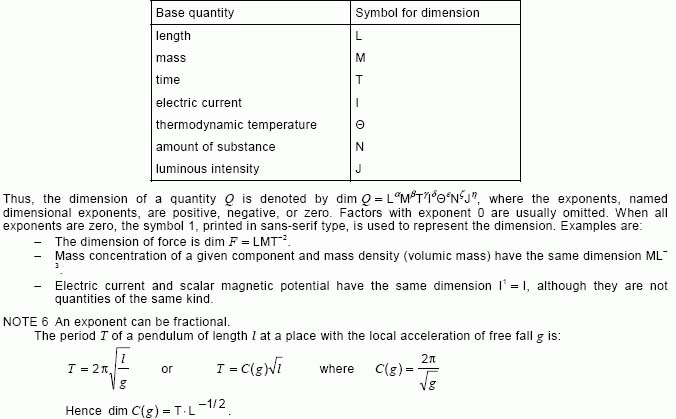
[IEV number 112-01-11]FR
dimension, f
dimension d'une grandeur, f
expression de la dépendance d’une grandeur par rapport aux grandeurs de base d'un système de grandeurs sous la forme d'un produit de puissances de facteurs correspondant aux grandeurs de base, en omettant tout facteur numérique
NOTE 1 – Une puissance d'un facteur est le facteur muni d'un exposant. Chaque facteur exprime la dimension d'une grandeur de base.
NOTE 2 – Par convention, la représentation symbolique de la dimension d'une grandeur de base est une lettre majuscule unique en caractère romain (droit) sans empattement. Par convention, la représentation symbolique de la dimension d'une grandeur dérivée est le produit de puissances des dimensions des grandeurs de base conformément à la définition de la grandeur dérivée. La dimension de la grandeur Q est notée dim Q.
NOTE 3 – Pour établir la dimension d'une grandeur, on ne tient pas compte du caractère scalaire, vectoriel ou tensoriel.
NOTE 4 – Dans un système de grandeurs donné, – les grandeurs de même nature ont la même dimension, – des grandeurs de dimensions différentes sont toujours de nature différente, – des grandeurs ayant la même dimension ne sont pas nécessairement de même nature. Par exemple, dans l'ISQ, la pression et l'énergie volumique ont la même dimension L–1MT–2. Voir aussi la note 5.
NOTE 5 – Dans le Système international de grandeurs (ISQ), les symboles représentant les dimensions des grandeurs de base sont:
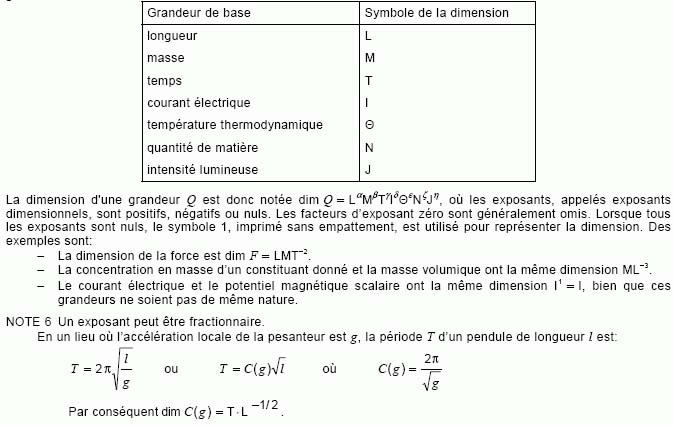
[IEV number 112-01-11]Тематики
- метрология, основные понятия
Синонимы
EN
DE
- Dimension einer Grösse
- Dimension, f
- Größendimension, f
FR
- dimension d'une grandeur, f
- dimension, f
2.9. Размерность физической величины
Размерность величины Нрк. Формула размерности
D. Dimension einer GroBe
E. Dimensions of a quantity
F. Dimension d’une grandeur
Выражение, отражающее связь величины с основными величинами системы, в котором коэффициент пропорциональности принят равным 1.
Примечания:
1. Размерность величины представляет собой произведение основных величин, возведенных в соответствующие степени.
2. Размерность производной величины отражает, во сколько раз изменяется ее размер при изменении размеров основных величин, например, если размерность величины х равна LaM^Tv и длина изменяется от / до /', масса — от m до т' и время — от t до то новый размер величины будет больше прежнего в (/'//)а
(/'//)v раз.
Источник: ГОСТ 16263-70: Государственная система обеспечения единства измерений. Метрология. Термины и определения оригинал документа
Русско-английский словарь нормативно-технической терминологии > размерность физической величины
-
7 в случае крайней необходимости
1) General subject: in case of emergence, in the worst extremity, when strictly necessary (напр., прибегать к использованию силы лишь в случае крайней необходимости - use force only when strictly necessary), if it comes to the push2) Colloquial: in emergency, in emergency3) Engineering: if absolutely necessary4) Graphic expression: when push comes to shove5) Advertising: in case of emergency6) Makarov: on emergencyУниверсальный русско-английский словарь > в случае крайней необходимости
-
8 завершить изложение доводов
Idiomatic expression: rest (one's) case (The drive will be too long, the seats too few, and the people too many. I rest my case.)Универсальный русско-английский словарь > завершить изложение доводов
-
9 закоренелый
1) General subject: brass collar, brassbound, case hardened, case-hardened, confirmed, crusted (о привычках, предрассудках), deep-rooted, desperate, double dyed, double-dyed, dyed in the wool, dyed-in-the-wool, engrained, hard core, impenitent, in grain, in grained, ingrain, ingrained, inveterate, of the blackest (deepest) dye, old, rock-ribbed (часто о членах республиканской партии США), thorough paced, thorough-paced, tough, hardline (hardline Communist), die-hard, old-school2) Rare: inworn3) Law: hardened, persistent4) Diplomatic term: hard-core5) Politics: absolute, arrant, blatant, hardcore, hopeless, out and out, outright, paid-up, total, unrelieved, utter6) Graphic expression: nuts-and-bolts (nuts-and-bolts fascist)7) Makarov: black, dye-in-the-wool, of the blackest dye, of the deepest dye -
10 исключение
1) General subject: elimination, exception, excision, exclusion, expulsion (из школы, клуба), expulsion (из школы, клуба и т.п.), expunction (части текста), reserve, shut-out (откуда-л.)2) Naval: salvo3) American: disfellowship (из учебного заведения, религиозной общины)4) Church: excommunication (из круга избранных и т.п.)5) Sports: omitting6) Military: deletion (из списков, из формулировки), preclusion7) Engineering: deletion8) Rare: dismemberment9) Mathematics: discrimination, dropping, elim (elimination), elimination (неизвестного), exception (неизвестного), exceptional case, rejection (statistics), screening-out10) Law: exemption, expulsion (из организации), expulsion (из организации.), expungement (из списка, текста), removal (из договора), save, saving, special case, disapplication (из правила, нормы и т.п.)()11) Economy: discarding, exclusion (в контракте)12) Accounting: exemption (для целей налогообложения), waiver13) Linguistics: (из правила) exception, counterexample14) Mining: exemption (из правил)15) Diplomatic term: expulsion (из организации и т.п.), suppression16) Psychology: exception (из правила и т. п.)17) Jargon: the bounce19) Oil: ruling out20) Genetics: excision (транспозона)21) Geophysics: rejection22) Metrology: cancellation23) Patents: omission, omission (части текста)24) Business: removal25) Network technologies: Exception (Информация о соединениях в сложном представлении узла PNNI, содержащая нечто отличное от используемого по умолчанию представления)26) EBRD: carve-out, carving-out27) Programming: exception (состояние программы, которое возбуждается ( активизируется), когда возникает какая-либо нештатная ситуация), excluding28) Quality control: exclusion (напр. изделий из испытаний)29) leg.N.P. exception (e.g., from a general rule), expulsion (e.g., from membership, from a college), proviso30) Chemical weapons: exception( written exemption) (письменное разрешение, допускающее отклонение от стандартов)31) Psychoanalysis: exception (из правила и т.п.)32) Makarov: exception (невключение, недопущение), exclusion (невключение, недопущение), expulsion (удаление), reservation, singularity33) Idiomatic expression: free pass (to have a free pass \<i\>to do smth\</i\> - иметь право делать что-л.) -
11 отказаться от участия в споре по причине своей явной правоты
Idiomatic expression: rest (one's) case (- It's time Nigel left home, or he'll never learn to be independent. - He doesn't even know how to boil an egg. - I rest my case.)Универсальный русско-английский словарь > отказаться от участия в споре по причине своей явной правоты
-
12 суть дела
1) General subject: core of the matter, core of the subject, point, salient facts, the core of a subject, the crux of the matter, the heart of the matter, the name of the game, the root of the matter, the essence of the matter, the main point2) Colloquial: the core of the matter, cliff notes3) Literal: kernel4) Engineering: subject matter5) Law: the record6) Diplomatic term: core of a problem, core of a subject, root of the matter, the core of a dispute, the matter in hand7) Psychology: heart of the matter8) Jargon: name of the game9) Graphic expression: brass tacks10) Patents: merit11) Business: fact of the matter -
13 приводить
reduce, reduce to, bring, cite, deduce, list, adduce, enter• Были приведены дальнейшие аргументы, показавшие, что... - Further arguments were given which showed that...• Было бы легко привести значительно больше примеров... - It would be easy to give many more examples of...• В основном, различные подходы приводят к... - Different approaches will, in general, lead to...• В свою очередь это может привести к тому, что... - This in turn can lead to...• В таблице 1 мы приводим вместе все данные относительно... - In Table 1 we summarize the...• В этом приложении мы приводим результаты... - In this appendix we present the results of...• Все эти данные приводили к очевидному требованию, что... - All this evidence led to a clear requirement that...• Дальнейшее рассуждение затем привело бы к идее... - Further argument would then lead to the idea of...• Данная процедура может быть продолжена, она приводит к... - The procedure can be continued, yielding...• Здесь мы приводим другой пример (чего-л). - We give here another example of...• Здесь мы приводим некоторые формулы для... - Неге we give some formulae for...• Исследование каждого случая отдельно приводит к... - Examination of each individual case leads to...• Можно привести еще одно замечание. - One further observation may be made.• Мы можем привести геометрическую интерпретацию для... -It is possible to give a geometric interpretation of...• Мы не можем привести здесь полный ответ. - We cannot give a complete answer here.• Мы не приводим это рассуждение со всеми подробностями по следующим причинам. - We do not present this argument in detail for the following reasons.• Мы приводим ниже значения для... - We quote below the values of...• Мы теперь приведем приложение уравнения (5). - We now give an application of (5).• Это привело нас к предложению, что... - We are led to the suggestion that...• Наши рассуждения в предыдущем параграфе могли бы привести нас к предположению, что... - Our work in the previous section might lead us to suspect that...• Однако здесь можно привести очень грубый довод. - A very rough reason, however, can be given here.• Описанный здесь метод всегда приводит... - The procedure described here always yields...• Перед тем как продолжить приводить примеры, мы приведем важное замечание, что... - Before proceeding to give examples, we make the important observation that...• Подобные повреждения могут привести к потере... - Such injuries can result in a loss of...• Понятно, что только один этот процесс не мог бы привести к... - Clearly such a process alone could not lead to...• Предыдущее обсуждение приводит к идее, что... - The preceding discussion leads to the idea that...• Приведем более полное доказательство, данное Гильбертом [2]. - A fuller proof, given by Hilbert [2], is as follows.• Приведем исключения, которые указывает Смит [1]. - Smith [1] points out certain exceptions as follows.• Приведем некоторый основной критерий для... - Let us list some major criteria for...• Приведем соответствующие численные величины:... - The corresponding numerical values are as follows:...• Приведем теперь пример, в котором... - We now give an example in which...• Процесс приводит к замене в... - The process leads to a change in...• Следовательно, мы обязаны попытаться развить теорию, которая приводит к... - Hence, we must try to develop a theory that leads to...• Смит [1] приводит убедительный пример существования... - Smith [l] makes a persuasive case for the existence of...• Сначала мы приведем некоторый дополнительный материал относительно... - We begin with some additional material relating to...• Сначала мы приведем один результат из... - We first quote a result from...• Такая практика приводит к серьезным недоразумениям. - This practice leads to serious confusion.• Тем не менее эта формальная работа привела к конкретному результату. - Nevertheless, this formal work has produced a concrete result. I• Тем самым нас довольно настойчиво приводит к идее, что... - This suggests quite strongly that...• Теперь мы приведем некоторые экспериментальные данные относительно... - We shall now give some experimental data concerning...• Теперь мы приведем список наиболее важных тождеств, включающих... - We shall now list the most important identities involving...• Теперь мы приведем явную характеристику... - We now give an explicit characterization of...• Теперь приведем несколько конкретных примеров. - A few concrete examples are in order.• Чтобы привести еще более простой пример, мы можем рассмотреть... - То take an even simpler example, we can consider...• Элегантное доказательство, которое мы здесь приводим, в основном принадлежит Гильберту. - The elegant proof we give is essentially due to Hilbert.• Эти кажущиеся тривиальными результаты приводят к... - These seemingly trivial results lead to...• Эти результаты мы приводим в таблице 1 для трех значений г. - The results are set out in Table 1 for three values of r.• Это выражение можно привести к более удобному виду. - This expression can be put in a more convenient form.• Это доказательство слишком сложное, чтобы приводить его здесь. - The proof is too complicated to give here.• Это естественным образом приводило к различным схемам для... - It led naturally to various schemes for...• Это заключение базируется на тех же самых идеях, которые приводят к... - This conclusion is based on the same ideas that lead to...• Это могло бы также привести к лучшему пониманию... - This could also lead to a better understanding of...• Это не приведет к ошибке, потому что... - This will not give rise to confusion because...• Это не приводит ни к каким концептуальным трудностям, однако... - This introduces no conceptual difficulties, but...• Это нестрогое рассуждение приводит нас к... - This crude argument leads to...• Это позволяет нам привести уравнение (1) к следующему виду... - This enables us to reduce (1) to the form...• Это привело нескольких авторов к заключению, что... - This has led several authors to believe that...• Это приводит к возникновению так называемого... - This gives rise to the so-called...• Это приводит к возрастанию... - This involves an increase in...• Это приводит к выводу, что... - This carries the implication that...• Это приводит к концепции... - This leads to a conception in which...• Это приводит к новым концепциям. - This leads to new conceptions.• Это приводит к полезным методам обращения с... - This leads to useful ways of dealing with...• Это приводит к противоречию, и, следовательно, доказательство закончено. - This gives a contradiction, and the proof is complete.• Это приводит к рассмотрению темы... - This leads into the topic of...• Это приводит к следующему определению. - This motivates the following definition.• Это приводит к тому, что известно как... - This leads to what is known as...• Это приводит нас к важному свойству... - This leads us to an important property of...• Это приводит нас к идее постулировать существование... - This leads us to postulate the existence of...• Этот результат автоматически приводит к необходимости изучения... - This result automatically leads to a study of... -
14 находить
1. найти (вн.)находить себя — find* oneself, или one's calling
находить удовольствие в чём-л. — find* / take pleasure in smth.
находить утешение — find* comfort
находить поддержку — find* support
находить (себе) выражение — find* expression
ничего не найти — find* nothing; draw* a blank идиом. разг.
найти нефть, рудную жилу — strike* oil, an ore vein
2. (полагать, считать) consider (d.), find* (d.)2. найти (на вн.)находить виновным — find* guilty (d.)
1. come* (over, upon); come* (across); (о туче, облаке и т. п. тж.) cover (d.)2. ( овладевать):что это на тебя нашло? — what has come over you?, what is the matter with you?
3. безл.:нашло много народу — there is a crowd, или a large gathering, of people
3. сов. разг.♢
нашла коса на камень погов. — it's a case of diamond cut diamond; he's met his match this time1. (рд., без доп.) cover a distance by walking2. (вн.; причинить хождением):находить мозоли на ногах — get* corns from walking
-
15 находить
I несов. - находи́ть, сов. - найти́; (вн.)1) ( обнаруживать отыскивать) find (d); ( открывать) discover (d)находи́ть удово́льствие в чём-л — find / take pleasure in smth
находи́ть утеше́ние — find comfort
находи́ть подде́ржку — find support
найти́ в себе́ доста́точно сил — be able to muster sufficient strength
ничего́ не найти́ — find nothing; draw a blank идиом. разг.
он ника́к не мог найти́ причи́ну э́того — he never managed to discover the cause of it
найти́ нефть [ру́дную жи́лу] — strike oil [an ore vein]
2) (полагать, считать) consider (d), find (d)до́ктор нахо́дит его́ положе́ние безнадёжным — the doctor considers his case hopeless
его́ нахо́дят у́мным — he is considered (to be) clever
находи́ть вино́вным — find guilty (d)
как вы его́ нахо́дите? (что вы о нём думаете) — how do you find him?
••находи́ть ну́жным (+ инф.) — find it necessary (+ to inf)
находи́ть (себе́) выраже́ние (в пр.) — find expression (in); manifest itself (in)
найти́ свою́ смерть (погибнуть) — meet one's death
найти́ себя́ — find oneself, find one's calling
не нахожу́ [не могу́ найти́] слов — words fail me; (для рд.; чтобы + инф.) I can't tell you (how, what, etc + clause)
найти́ в себе́ му́жество (+ инф.) — find the courage (+ to inf)
II несов. - находи́ть, сов. - найти́; (на вн.)найти́ в себе́ си́лы (+ инф.) — bring oneself (+ to inf)
1) (двигаясь, приблизиться) come (over, upon); come (across); (о туче, облаке и т.п. тж.) cover (d)2) (на вн.; овладевать - о чувствах, настроении) come (over, upon); тж. переводится выражениями be seized (with), have an attack (of)на него́ нашла́ тоска́ — he had an attack [a fit] of depression
что э́то на тебя́ нашло́? — what has come over you?, what's got брит. / gotten амер. into you?
3) сов. ( прибыть) come, gather, arriveнашло́ мно́го наро́ду — there is a crowd [a large gathering] of people
••III сов. разг.нашла́ коса́ на ка́мень погов. — ≈ it's a case of diamond cut diamond; he's met his match this time
1) (рд.; пройти какое-л расстояние) cover a distance by walking2) (вн.; причинить себе хождением) get (d) ( as a result of walking); walk to the point of getting (d)находи́ть мозо́ли на нога́х — get corns from walking
-
16 критический двигатель (двигатели)
Двигaтeль (двигaтeли), oткaз кoтoрoгo (кoтoрых) oкaзывaeт нaибoлee нeблaгoприятнoe вoздeйствиe нa хaрaктeристики вoздушнoгo суднa, oтнoсящиeся к рaссмaтривaeмoму случaю.critical power-unit(s); critical engine(s)The power-unit(s) failure of which gives the most adverse effect on the aircraft characteristics relative to the case under consideration.Note.— On some aircraft there may be more than one equally critical power-unit. In this case, the expression ‘the critical power-unit’ means one of those critical power-units.(AN 8)Official definition modified by Amdt 100 to AN 8 (13/04/2005).Русско-английский словарь международной организации гражданской авиации > критический двигатель (двигатели)
-
17 в скобках
•In this case, the bracketed (or parenthetical) expression must be zero.
•The term in brackets (or in parentheses) stands for...
Русско-английский научно-технический словарь переводчика > в скобках
-
18 в скобках
•In this case, the bracketed (or parenthetical) expression must be zero.
•The term in brackets (or in parentheses) stands for...
Русско-английский научно-технический словарь переводчика > в скобках
-
19 иметь вид
•The region has the aspect of an undulating plane.
•The exact notation will look like:...
•The reagents are in the form of solids, liquids, or gases.
•The ammonium chloride formed appears as smoke or as a white deposit.
•The total voltage applied to the plate has the appearance (or shape) shown in Fig. 2.
•The resultant rf carrier appears as in Fig. 3.
•The closure usually takes (or has) the form of a cap or plug.
•In this case the equation takes the form:...
Русско-английский научно-технический словарь переводчика > иметь вид
-
20 игра в одни ворота
1) Phraseological unit: one-sided relationship2) Idiomatic expression: "a one-way street" caseУниверсальный русско-английский словарь > игра в одни ворота
См. также в других словарях:
Case Study House — Case Study Houses Le programme des Case Study Houses est une expérience architecturale visant à construire des maisons modernes et économiques. Il se déroule sur la côte ouest des États Unis, principalement autour de Los Angeles entre 1945 et… … Wikipédia en Français
Expression Rationnelle — Pour les articles homonymes, voir régulier et rationnel. Une expression rationnelle ou expression régulière[1] est en informatique une chaîne de caractères que l’on appelle parfois un motif et qui décrit un ensemble de chaînes de caractères… … Wikipédia en Français
Expression régulière — Expression rationnelle Pour les articles homonymes, voir régulier et rationnel. Une expression rationnelle ou expression régulière[1] est en informatique une chaîne de caractères que l’on appelle parfois un motif et qui décrit un ensemble de… … Wikipédia en Français
Expression (Programmation Informatique) — Pour les articles homonymes, voir Expression. Une expression d un langage de programmation est une combinaison de valeurs, variables, opérateurs, et de fonctions qui sont interprétés (évalués) selon des règles particulières de précédence et d… … Wikipédia en Français
Expression (programmation informatique) — Pour les articles homonymes, voir Expression. Une expression d un langage de programmation est une combinaison de valeurs, variables, opérateurs, et de fonctions qui sont interprétés (évalués) selon des règles particulières de précédence et d… … Wikipédia en Français
Expression pedal — An expression pedal is an important control found on many organs and synthesizers that allows the volume of the sound to be manipulated. Because the source of power with a pipe organ and electronic organs is not generated by the organist, the… … Wikipedia
Case Study Houses — Le programme des Case Study Houses est une expérience architecturale visant à construire des maisons modernes et économiques. Il se déroule sur la côte ouest des États Unis, principalement autour de Los Angeles entre 1945 et 1966. Sommaire 1… … Wikipédia en Français
Expression index — An expression index is a database index that is built on a generic expression, rather than on a list of columns. This allows indexes to be defined for common query conditions that depend on data in a table, but are not actually stored in that… … Wikipedia
Expression rationnelle — Pour les articles homonymes, voir régulier et rationnel. Une expression rationnelle ou expression régulière[1] est en informatique une chaîne de caractères que l’on appelle parfois un motif et qui décrit un ensemble de chaînes de caractères… … Wikipédia en Français
expression — by Claire Colebrook Expression is one of Deleuze s most intense concepts. If we take Deleuze s definition of a concept that it is a philosophical creation that produces an intensive set of ordinates then expression can be understood as… … The Deleuze dictionary
expression — by Claire Colebrook Expression is one of Deleuze s most intense concepts. If we take Deleuze s definition of a concept that it is a philosophical creation that produces an intensive set of ordinates then expression can be understood as… … The Deleuze dictionary
